
Bereavement in Singapore comes with a vocabulary drawn from three places at once: Chinese religious practice, British-inherited administrative language, and the specific names of local government facilities and permits. Families encounter all three in the same week, usually for the first time.
This glossary defines the terms that actually come up, grouped by where you will meet them. Where a term refers to a Singapore government fee, facility or rule, the figure or requirement is as published by the relevant authority at the time of writing.
The administrative terms
Digital death certificate
The record produced when the attending doctor certifies a death and submits the information online to the Immigration and Checkpoints Authority. Under the current process the family does not lodge a separate registration.
Manual Confirmation of Death, or mCOD
An accepted alternative to the digital death certificate for the purposes of applying for a Permit to Bury or Cremate. A public hospital printout from the National Electronic Health Record is also accepted.
Permit to Bury or Cremate
The NEA permit required before a burial or cremation slot may be used. Normally applied for by the funeral director.
Letter of Authorisation
The document required where the person applying for a cremation or a niche is not a next-of-kin. A separate version exists for Stay-in-Care residents and MSF residential homes.
Stay-in-Care
NEA’s term covering hospitals, nursing homes, hospices, shelters and senior group homes. It matters because it changes which Letter of Authorisation applies.
Letter of Undertaking
An additional document NEA requires in certain niche booking circumstances.
Temporary Occupation Licence, or TOL
The licence from the Singapore Land Authority required for a wake at a private or landed property that uses public roads or walkways, or for a wake on state land. A prevailing fee applies.
NEA ePortal
The National Environment Agency’s online service for cremation bookings, niche bookings, ash scattering bookings and applications such as a wake extending beyond seven days.
A.S.K. checklist
A Competition and Consumer Commission Singapore checklist for engaging funeral providers, produced with NEA’s support out of a market study of Singapore funeral services. It stands for ascertain the wishes of the deceased and the family, seek clear answers so you know what you are paying for, and know the useful independent sources.
The facilities
Crematorium
The facility where a body is cremated. Singapore has four: Mandai Crematorium and Mandai North Crematorium, both government-managed, and Kong Meng San Phor Kark See Monastery and Tse Tho Aum Temple, both private.
Columbarium
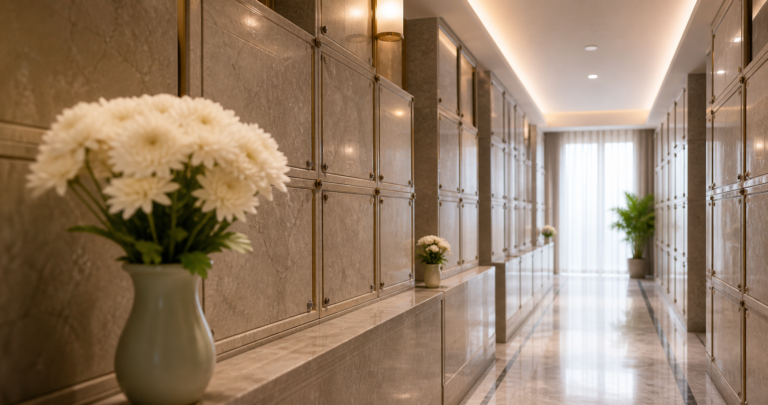
A building or structure of recessed compartments for storing urns of cremated ashes. Two are NEA-managed, at Choa Chu Kang and Mandai, and many are private.
Niche
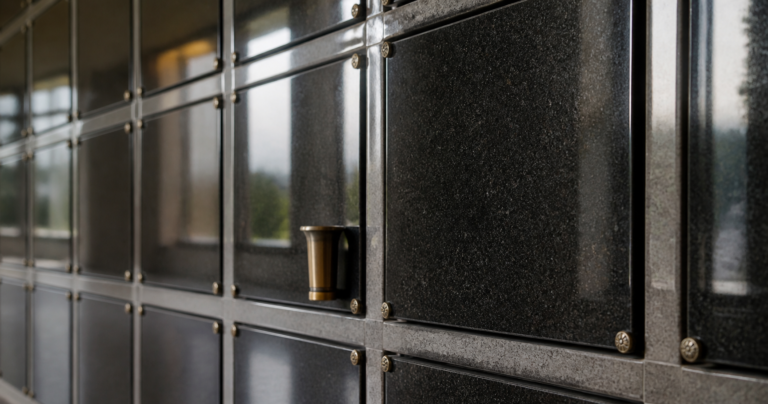
An individual compartment within a columbarium, sealed with a plaque. At government columbaria a standard niche costs $500 and holds around two urns; a family niche costs $900 and holds around four.
Selection fee
The $250 charge at government columbaria for choosing a niche location other than the one allocated. Niches are otherwise allocated sequentially.
Ash Collection Centre
Where families collect ashes after a cremation, on a later date rather than the same day. There is one at Choa Chu Kang Crematorium, 960 Old Choa Chu Kang Road, and one at Mandai Crematorium, 300 Mandai Road.
Garden of Peace and Garden of Serenity
NEA’s inland ash scattering facilities. The Garden of Peace is at Choa Chu Kang Cemetery and accepts scattering from 9am to 5pm daily, with a $320 booking fee. Only fine ashes may be scattered.
Choa Chu Kang Cemetery Complex
The only cemetery in Singapore open for burials.
Crypt burial system
An NEA burial arrangement distinct from a conventional grave plot.
Funeral parlour
An indoor venue for a wake. Parlours with embalming facilities are licensed by NEA.
Void deck
The open ground-floor space beneath an HDB block, the most common wake venue in Singapore. Requires a Town Council permit.
The procedures
Embalming
A procedure delaying decomposition by removing bodily fluids and replacing them with formaldehyde-based solutions. Required for a wake with viewing or an open casket, and typical where a body is transported across borders.
Hermetically sealed coffin
A coffin without a viewing window, which permits a wake without embalming for a period not exceeding seven days after death.
Direct cremation and direct burial
Sending the body for cremation or burial shortly after death with no wake. Recognised by NEA as a legitimate option.
Encoffining
Washing, dressing and placing the body in the casket, usually on the first day of a wake.
Exhumation
Removing remains from a grave. In Singapore this is not exceptional: since 1 November 1998 the burial period for all graves has been limited to 15 years, after which graves are exhumed.
Basic Infection Control Course, or BICC
The National Centre for Infectious Diseases course that a funeral services provider must have completed before managing a deceased person with a highly infectious disease.
Inland ash scattering
Scattering fine ashes at an NEA garden facility, as distinct from scattering at sea.
Ash soil transfer
NEA’s periodic movement of accumulated ash soil from the scattering lanes to a designated location within the Garden of Peace, so the lanes stay available for use.
The Chinese religious terms
Ling tang
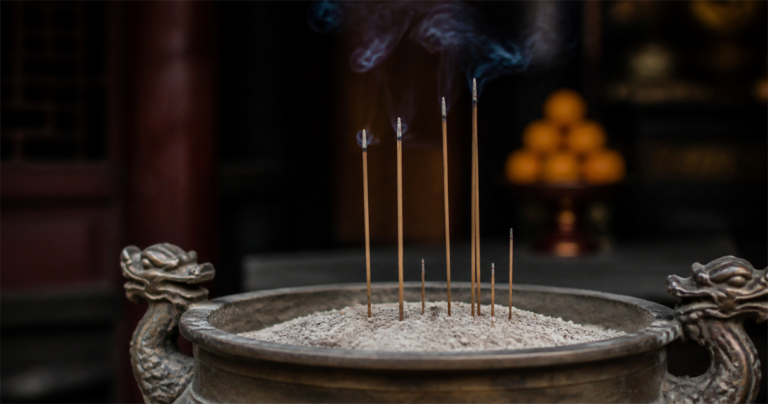
The mourning hall: the arrangement holding the casket, the portrait of the deceased, a continuously lit oil lamp, food and fruit offerings, and an incense urn.
Ancestral tablet
An inscribed plaque bearing a deceased family member’s name, placed at a temple or in the home to receive ongoing veneration. It holds no ashes and is a separate item from a niche.
Ancestral pedestal
The stand or mount an ancestral tablet sits in or on. Often quoted together with the tablet, which causes confusion about what is being bought.
Ancestor veneration
The practice of making offerings and prayers to deceased family members, directed at a tablet or a grave. Also written as ancestral worship or ancestor worship.
The observances after the funeral
Chinese practice treats a death as starting a calendar rather than closing one. These are the recurring dates a family will be asked about for years afterwards.
Qing Ming
The annual tomb-sweeping festival, around early April, when families clean graves, niches and tablets and make offerings. The busiest day of the year at any Singapore columbarium.
The seven seven-day cycles
Prayers held every seventh day after a death across seven cycles, ending on the forty-ninth day. The first and seventh carry the most weight.
The hundredth day
A memorial prayer one hundred days after the death, widely observed in Singapore.
Hungry Ghost Festival
Observances in the seventh lunar month, with offerings for the dead generally rather than for one named ancestor.
Paper offerings
Paper effigies, spirit money and paper models of goods, burned so their value passes to the deceased. A prominent feature of Taoist funerals.
Dharani blanket
A blanket printed with sacred text, placed with the deceased in some Buddhist funerals. Also referred to as a funeral blanket.
Dialect tradition
Hokkien, Teochew, Cantonese, Hainanese and others. Within Taoist and Buddhist practice the sequence of rites often follows the family’s dialect tradition rather than a single standard, which is why relatives from different branches can both be correct about incompatible details.
The commercial terms
These are the words that appear in a quote rather than in a ritual, and they are where the money is decided. Providers use several of them loosely, so it is worth being able to pin down which one is actually on offer.
| Term | What it means | What to ask |
|---|---|---|
| Funeral package | A bundled offer. Inclusions differ substantially between providers, which is the main reason two quotes resist comparison. NEA notes that components vary with religious beliefs, family preferences and customs. | What is in it, line by line |
| Pre-planning | Agreeing arrangements with a provider without paying in advance. | Is anything prepaid, and can I change it |
| Pre-need | Paying in advance for services delivered years later. | Where are the funds held, is it refundable, is it transferable, what if you cease trading |
| Itemised quote | A quote showing each component separately, with government fees distinguished from the provider’s own charges. | Which lines are fixed government fees |
| NEA-registered contractor | The only category permitted to carry out niche plaque work, or erect a tombstone or monument, at NEA-managed facilities. | Can you show your registration |
| Direct cremation | Cremation shortly after death with no wake. Recognised by NEA. | What is excluded compared with a standard package |
The people you will deal with
Half a dozen roles appear in the space of a week, and families frequently do not know which of them they are speaking to or what that person can decide.
- The certifying doctor certifies the death and submits it online to ICA. Nothing else in the sequence can begin until this is done.
- The funeral director applies for the Permit to Bury or Cremate, books the slot, obtains the wake venue approvals and coordinates everything else. In practice this is the most consequential choice a family makes.
- The next-of-kin has standing to make applications and authorise changes. NEA requires cancellations and changes to confirmed bookings to be made in person by the applicant or a next-of-kin.
- The applicant is not always a next-of-kin. Where they are not, a Letter of Authorisation is required, with a separate version for Stay-in-Care and MSF residential home residents.
- The priest, monk or celebrant leads the religious observances. In Taoist and Buddhist practice the relevant question is usually which temple and which dialect tradition rather than which individual.
- The geomancer is consulted by some families on dates, orientation and niche position. This sits alongside the religious rites rather than within them.
- The embalmer works at a parlour licensed by NEA where embalming facilities are involved.
- The plaque contractor must be NEA-registered for work at NEA-managed facilities.
Words for the money you may be asked for
Three quite different things get described as a fee, and only the first is fixed.
- A published government fee is set by an authority and identical for everyone. Cremation, burial, government columbarium niches and inland ash scattering are the four that exist. A standard government niche is $500 and cremation at a government crematorium is $100 for an adult.
- A prevailing fee is the phrase used for the SLA Temporary Occupation Licence, meaning the rate current at the time rather than a fixed published figure.
- A provider charge covers everything else: the casket, the wake, the venue set-up, transport, the urn, the plaque, the priest, embalming and the director’s own fee. None of it is government-set, and together it is the large majority of a Singapore funeral bill.
A recurring charge is the one to watch for specifically, because it is what makes two apparently similar niche quotes diverge over thirty years. Ask whether a fee is one-time or annual before comparing any two numbers.
Words that mean something different here
Several of these terms carry a different meaning in Singapore than a reader would assume from overseas usage, and the mismatch causes real confusion.
- Cemetery is a general category elsewhere. In Singapore it means effectively one place, because Choa Chu Kang Cemetery Complex is the only cemetery open for burials.
- A burial plot is often perpetual elsewhere. In Singapore every grave is subject to a 15-year burial period, after which it is exhumed, so nothing here is bought in perpetuity.
- Reserving a plot or niche is familiar practice in many countries. At a Singapore government columbarium it does not exist, because no advance booking of niches is allowed and allocation is sequential.
- Funeral home in American usage means a single business handling everything on its own premises. In Singapore the wake is far more often at a void deck, with the parlour a separate and more expensive option.
- Death registration is elsewhere a task for the family at a registry office. In Singapore the doctor certifies and submits online to ICA, and the registration follows from that.
- Scattering ashes is not simply a matter of choosing a spot. Two designated government locations exist, and only fine ashes may be scattered at the gardens.
Terms that are commonly confused
| These two | Are not the same |
|---|---|
| Niche and ancestral tablet | The niche holds the ashes. The tablet receives the veneration and holds nothing. |
| Tablet and pedestal | The tablet is the inscribed plaque. The pedestal is what it sits on. |
| Cremation fee and niche fee | Separate services, separate fees. The $327 published for Bright Hill is a cremation fee, not a niche price. |
| Bright Hill and Guang Ming Shan | The same monastery under English and Chinese names. |
| Choa Chu Kang Columbarium and Choa Chu Kang Crematorium | Different facilities at different addresses. The columbarium is at 51 Chinese Cemetery Path 4; the ash collection centre is at 960 Old Choa Chu Kang Road. |
| Certification and registration | A doctor certifies. ICA registers, automatically, from the doctor’s online submission. |
| Wake and funeral | The wake is the period of receiving visitors. The funeral proper is the committal on the final morning. |
Where to read more on each
- Niches, fees and booking rules: columbarium niches in Singapore and Choa Chu Kang Columbarium
- Comparing niche prices: how to compare columbarium niche prices
- Urns: cremation urns in Singapore
- Tablets and pedestals: ancestral tablets in Singapore, tablet placement and ancestral pedestals
- The wake: venues, duration and etiquette
- Timelines: how long a funeral takes in Singapore
- The rules: Singapore death and funeral regulations
- Every published fee: published death-care fees in Singapore
- Costs in practice: funeral costs in Singapore and what funeral packages include
- The mourning calendar: the 49-day and 100-day periods
- Taoist rites: Taoist funerals in Singapore
- Buddhist rites: Singapore Buddhist funeral customs and the Buddhist and Taoist guide
- The funeral blanket: Buddhist funeral blanket
- Christian comparison: Buddhist and Christian funerals compared
- Cremation: the process, what happens after, religious views and compared with burial
- Ash disposition: the options
- Burial and exhumation: the burial guide, why exhumation is required, the process, the cost, the permit and night rituals
- Feng shui: feng shui in Singapore funerals
- Planning: the advance planning checklist and pre-planning
- Starting point: what to do when someone passes away in Singapore, the funeral process and choosing a funeral service
Speaking to someone
Nirvana Memorial Garden arranges Buddhist, Taoist, Christian and Catholic funerals in Singapore and provides columbarium niches and ancestral tablets. If a term has come up in a quote or a conversation and you are not sure what you are being offered, ask us and we will explain it plainly.
Call +65 6363 6363 or email contact@nirvanasingapore.sg.
Government fees, facility details and regulatory requirements in these definitions are as published by the National Environment Agency, the Maritime Port Authority and the Competition and Consumer Commission Singapore at the time of writing. Religious definitions describe common Singaporean practice and vary between lineages, dialect traditions and temples. Fees and rules change.