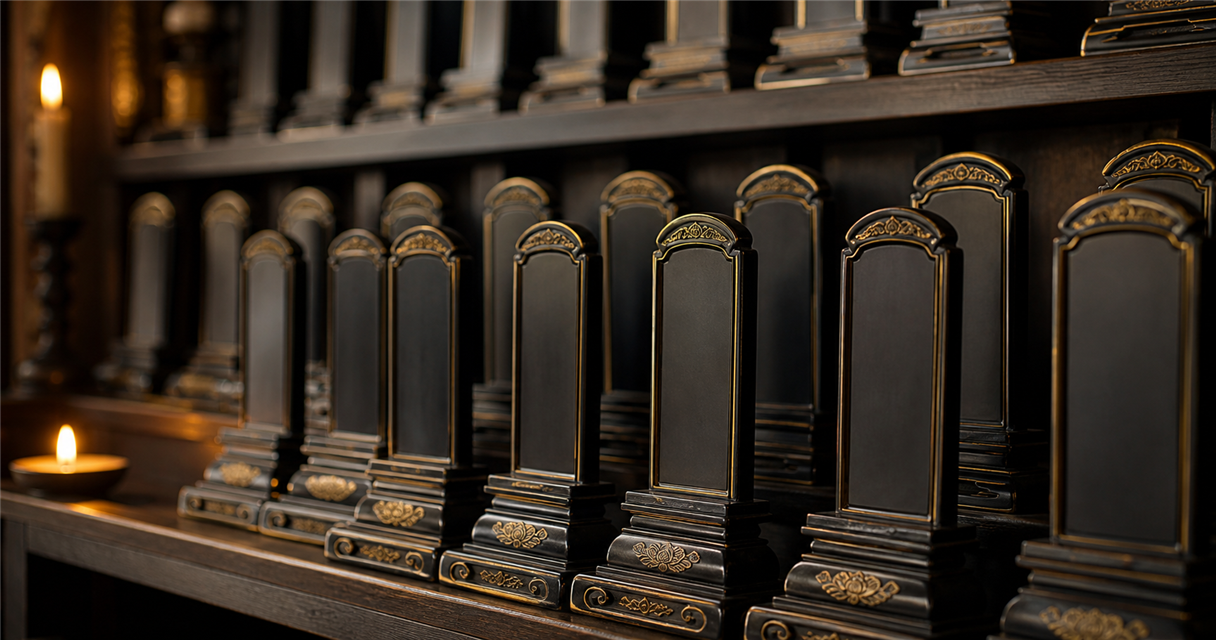
An ancestral tablet is a wooden or stone plaque bearing the name of a deceased family member, placed at a temple or in the home so that the family has a fixed point at which to make offerings. It is not a container for ashes. That distinction confuses almost everyone encountering the practice for the first time, and it is the reason a family can hold both a columbarium niche and an ancestral tablet without duplication: the niche holds the remains, the tablet receives the veneration.
This guide covers what the tablet is, where Singaporean families place one, what the practice actually involves through the year, and the questions worth asking before committing to a temple. It also addresses the situation families most often write in about, which is inheriting a tablet nobody explained.
What an ancestral tablet is
The object
A tablet is typically a vertical plaque, most often wood, sometimes stone or a composite. The face carries the deceased’s name, usually in Chinese characters, frequently with dates and a generational designation indicating the person’s place in the family line. Some tablets carry a photograph. Sizes vary by temple, because the temple’s own shelving and hall layout dictate what fits.
What it is for
The tablet is the addressable point for ancestor veneration. Offerings, incense and prayers are directed at it. In the logic of the practice, the tablet is where the ancestor is present to the family, which is why its placement is treated as a considered decision and not a storage question.
What it is not
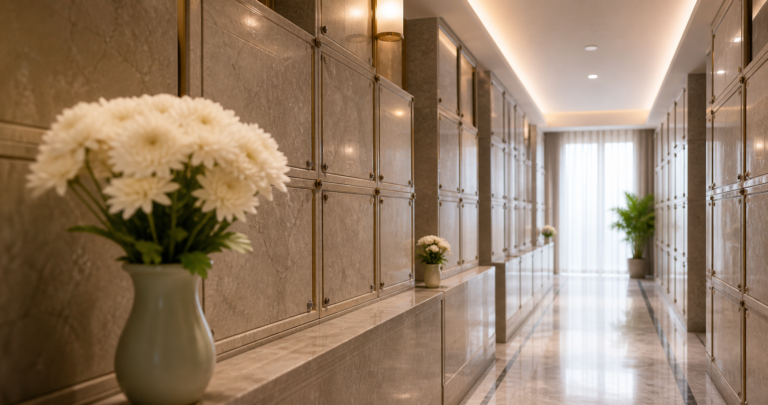
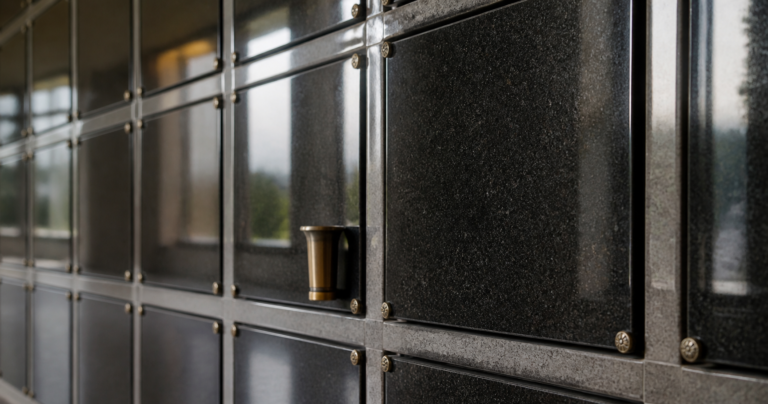
It is not an urn, not a niche, and not a gravestone. If you are looking for where cremated ashes are kept, that is a columbarium niche, and our guide to columbarium niches in Singapore covers it, along with the government fee schedule. A family will often place the ashes in a niche and the tablet in a hall, sometimes at the same facility and sometimes not.
Tablet, pedestal, or both
Singaporean families use two related terms and providers do not always distinguish them clearly.
| Term | What it is | What it holds |
|---|---|---|
| Ancestral tablet | The inscribed plaque itself | The name, and the veneration |
| Ancestral pedestal | The stand or mount the tablet sits in or on | The tablet |
| Columbarium niche | A sealed compartment in a columbarium | The urn of ashes |
In practice a quotation for a “tablet” often includes the pedestal, and a quotation for a “pedestal” often assumes a tablet. Ask which of the three you are buying. Our page on ancestral pedestals covers the mount, and our tablet service page covers placement.
Where a tablet is placed
At a temple
The most common choice in Singapore. A temple maintains an ancestral hall with rows of tablets, conducts scheduled prayers, and provides a place for families to make offerings on the significant dates. The practical draw is that the observances continue whether or not the family attends in a given year.
At a memorial park or columbarium
Facilities that provide niches often provide tablet placement in the same building, which allows one visit rather than two. For elderly families this matters more than the aesthetics of either hall.
At home
Home placement is traditional and still practised. A domestic altar holds the tablet alongside offerings, incense and often a deity image. The consideration families weigh is continuity: a home altar depends on the household maintaining it, and it moves when the household does.
How families choose between the three
The question underneath the choice is usually who will be responsible in thirty years. A temple or memorial park placement transfers the maintenance burden to an institution. A home altar keeps the practice inside the family and closer to daily life. Neither is more correct, and plenty of families do both, with a home altar for daily incense and a temple tablet for the formal observances.
What goes on the tablet
The name
Names are usually inscribed in Chinese characters even where the family speaks English day to day. Getting the characters right matters and is worth verifying against an identity document rather than from memory, because the inscription is permanent.
Generational designations
Traditional inscriptions place the deceased within the family line, indicating whether the person was a father, grandfather, great-grandfather and so on relative to the family installing the tablet. This is why the same person’s tablet can be worded differently by different branches of a family, and why families sometimes discover an apparent inconsistency between two tablets that is not an error.
Dates
Dates of birth and death are common. Some families use the lunar calendar date, which is what the annual observances are calculated from, and some use the Gregorian date, and some both. If the family intends to observe the death anniversary by the lunar calendar, record that date somewhere durable at the time, because converting it back later is avoidable work.
Photographs
Widely used and generally optional. Temples differ on whether photographs are permitted in a given hall, so confirm before commissioning one.
The annual calendar a tablet creates
A tablet is not a one-off purchase. It creates a set of recurring dates, and families new to the practice are usually surprised by how many.
Qing Ming
The tomb-sweeping festival, and the principal annual observance. Families visit, clean the tablet and its surrounds, and make offerings. If the family also holds a niche, both are usually visited in the same trip.
The death anniversary
Observed annually, commonly by the lunar date. This is the most personal of the observances and the one most often kept when others lapse.
The Hungry Ghost Festival
Observed in the seventh lunar month, with offerings for the dead generally rather than for one ancestor. Many temples run their own rites during this period.
Winter solstice and lunar new year
Both carry ancestral observances in Chinese practice, with offerings made at the tablet before the family’s own celebrations.
The observances in the first year
Before the annual cycle begins there is a first-year sequence: prayers every seventh day for seven cycles, ending on the forty-ninth day, then the hundredth day, then the first anniversary. Our guide to the 49-day and 100-day mourning periods sets out the full calendar and what happens at each point.
The annual dates at a glance
Families installing a first tablet find it useful to see the whole year in one place, because the observances are calculated on two different calendars and the lunar ones move against the Gregorian date every year.
| Observance | When | Calendar | Scope |
|---|---|---|---|
| Seven seven-day cycles | Every 7th day for 49 days after the death | Counted from the date of death | First year only |
| Hundredth day | 100 days after the death | Counted from the date of death | First year only |
| Death anniversary | Annually | Usually lunar | The individual ancestor |
| Qing Ming | Around early April | Solar term | All ancestors |
| Hungry Ghost Festival | Seventh lunar month | Lunar | The dead generally |
| Winter solstice | Around late December | Solar term | All ancestors |
| Lunar new year | Varies, Jan to Feb | Lunar | All ancestors |
No family observes every one of these, and the tablet does not oblige anyone to. What the table is useful for is deciding deliberately which observances the family intends to keep, rather than discovering a date has passed and feeling obliged to explain it. Temples that include scheduled prayers in the placement fee will typically cover Qing Ming and the seventh lunar month regardless of whether the family attends.
Which tradition the tablet belongs to
Taoist practice
Ancestor veneration through a tablet is central rather than peripheral. The tablet is usually installed after the funeral rites conclude, and the priest who led the funeral is often involved. Our guide to Taoist funerals in Singapore covers the sequence that leads to installation.
Buddhist practice
Tablets are common in Singaporean Chinese Buddhist practice, placed in temple ancestral halls, and the merit-dedication framing sits differently from the Taoist one while the observable practice looks similar. Our Buddhist and Taoist funeral guide and Singapore Buddhist funeral customs cover both.
Christian and Catholic families
Ancestral tablets are generally not part of Christian practice, and families of mixed religion frequently have to negotiate this. In Singapore the common resolution is that the Christian members attend and pay respects without making offerings, which most families find workable. The difference between Buddhist and Christian funerals covers the wider question, and religious views on cremation covers the related one.
Where feng shui enters
Placement, orientation and timing of installation are all subjects on which a geomancer may be consulted, and this is separate from the religious rites rather than part of them. Our page on feng shui in Singapore funerals covers how the two run alongside each other.
What a tablet costs
There is no published government fee for an ancestral tablet, because tablets are placed at temples and private facilities rather than at NEA-managed sites. NEA publishes fees for cremation, burial and columbarium niches; the tablet sits outside that schedule entirely.
That means the price is set by the facility, and it varies widely with the hall, the position within it, the material of the tablet, and whether ongoing prayers are included. We do not print a figure here, because any single number would mislead most readers. What is worth knowing is the structure of the cost: the tablet and its inscription, the placement, and any recurring charge for prayers or maintenance. The third of those is the one to pin down in writing.
For the funeral costs that precede this decision, our breakdown of funeral costs in Singapore covers the arrangements, and what funeral packages include covers whether tablet placement is bundled, which it sometimes is.
Transferring or relocating a tablet
Why it comes up
Tablets get moved. A temple closes or redevelops, a family emigrates, a household consolidates two branches’ tablets into one hall, or an exhumation programme changes where the associated remains are held.
How it is handled
A transfer is treated as a rite rather than a removal. Temples have their own procedures, and the receiving facility will usually specify what it requires. Where the transfer accompanies the relocation of remains, the exhumation side has its own process: our pages on the exhumation process, why exhumation is required and applying for the NEA exhumation permit cover it, and exhumation costs covers the money.
The 15-year burial rule that forces the question
Since 1 November 1998 the burial period for all graves in Singapore has been limited to 15 years, after which graves are exhumed. Where the religion permits cremation, exhumed remains are cremated and placed in a columbarium niche. Families that chose burial a generation ago are therefore reaching the point where remains move and, often, where the tablet arrangement is revisited at the same time. The Choa Chu Kang cemetery burial guide covers the site where most of this happens, and night exhumation rituals covers the observances some families keep.
Inheriting a tablet nobody explained
This is the most common question we receive on the subject. Someone dies, and the family finds a tablet at a temple they were only vaguely aware of, with no record of what was agreed or what is still owed.
What to establish first
- Which facility holds it, and in which hall or row
- Whether any recurring charge is outstanding, and to whom
- Whether associated remains exist, and where
- What the family has historically observed, and on which dates
Where the answers usually are
Temple receipts, a red packet of documents kept by the eldest of the previous generation, and the funeral director who handled the original arrangements. Providers keep records longer than families expect, and a phone call to the facility with a name and an approximate year is often enough.
Leaving better records than you inherited
The practical lesson families draw from this is to write down the facility, the location within it, the contractor who did the inscription and the observance dates, and to leave that with the will rather than in someone’s memory. Our advance funeral planning checklist covers what belongs in that document.
Questions to ask a temple or facility
The Competition and Consumer Commission Singapore’s A.S.K. checklist for funeral providers applies here too: ascertain the family’s and the deceased’s wishes, seek clear answers about what you are paying for, and know the sources you can check independently. Applied to a tablet, five questions do most of the work.
- Is the placement fee one-time, or is there a recurring charge, and for how long?
- Are scheduled prayers included, and at what frequency?
- What are the visiting hours, and what changes at Qing Ming and during the seventh lunar month?
- Who inscribes the tablet, and can the wording be verified before it is cut?
- What happens if the facility redevelops or relocates the hall?
How this fits the rest of the arrangements
A tablet is one of the last things arranged and one of the longest-lived. The sequence before it runs from what to do when someone passes away in Singapore, through the funeral process and the cremation process, to what happens after cremation and the choice between a niche and the other ash disposition options. Families still choosing between cremation and burial should read the comparison first, and families choosing a provider, how to choose a funeral service in Singapore.
Speaking to someone
Nirvana Memorial Garden provides ancestral tablets and pedestals in Singapore alongside columbarium niches and Buddhist, Taoist, Christian and Catholic funeral services. If you are arranging a tablet for the first time, or trying to establish what a family already holds, our team can help you work it out without obligation.
Call +65 6363 6363 or email contact@nirvanasingapore.sg.
Government fees referenced in this guide are as published by the National Environment Agency at the time of writing. Ancestral tablet pricing is set by individual temples and facilities and is not government-regulated, so confirm current terms directly with the facility.