The funeral is not the end of the observances. In Chinese practice a death starts a calendar: prayers every seventh day for forty-nine days, a memorial at one hundred days, and an anniversary each year afterwards. Families who have just been through a wake are often surprised to learn there is more, and nobody explained the dates.
This guide sets out the whole calendar, what happens at each point, how the dates are actually calculated, and what a family is and is not obliged to observe. It also covers what Buddhist, Taoist and Christian families in Singapore do differently, because the same household frequently contains all three.
The calendar in one table
| Observance | When | Counted from | Recurs |
|---|---|---|---|
| First seventh day | Day 7 | The date of death | No |
| Second to sixth seventh days | Days 14, 21, 28, 35, 42 | The date of death | No |
| Seventh seventh day | Day 49 | The date of death | No |
| Hundredth day | Day 100 | The date of death | No |
| First anniversary | One year | Usually the lunar date of death | No |
| Third anniversary | Three years | Usually the lunar date of death | No |
| Death anniversary | Annually | Usually the lunar date of death | Yes |
| Qing Ming | Around early April | Solar term | Yes |
| Hungry Ghost Festival | Seventh lunar month | Lunar calendar | Yes |
| Winter solstice | Around late December | Solar term | Yes |
| Lunar new year | January or February | Lunar calendar | Yes |
The seven seven-day cycles
Why forty-nine days
Seven observances, seven days apart, ending on the forty-ninth day. In Buddhist understanding the period corresponds to the transition of consciousness between one existence and the next, and the prayers are offered to assist that passage. Taoist practice frames it as the soul’s journey through a series of stages. Either way the logic is the same: the period after death is treated as ongoing rather than closed, and the family’s role continues through it.
Which of the seven are actually observed
The first and the seventh carry the most weight. Many Singaporean families observe those two properly and mark the intermediate ones lightly or not at all. This is normal and not a failure of duty. Families with a tablet at a temple often find the temple observes the full sequence on their behalf regardless of attendance.
What happens on a seventh day
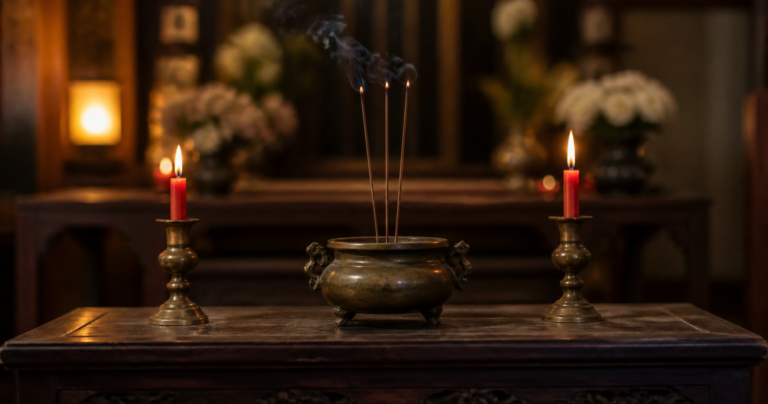
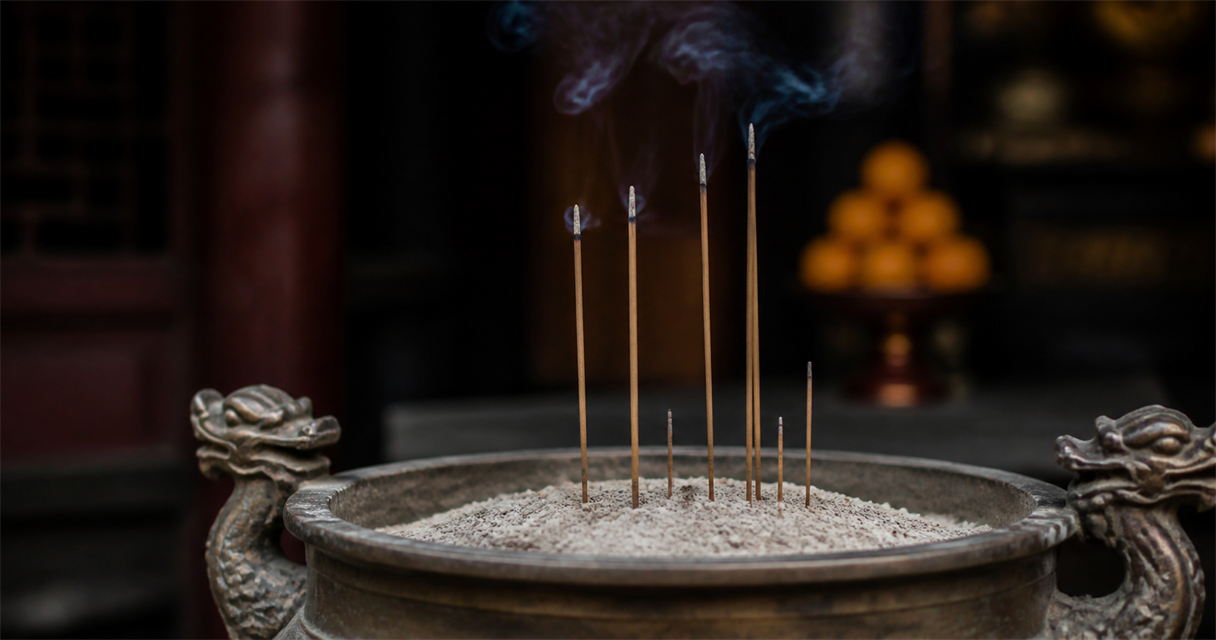
Prayers, offerings of food, incense, and in Taoist practice the burning of paper offerings. It is a household or small-group observance rather than a public event, and it may be held at home, at a temple, or at the columbarium where the ashes are placed.
Counting the days
The count runs from the date of death, and the day of death itself is counted as day one in many families’ reckoning, which is why two branches of the same family can arrive at dates a day apart. Agree the convention once, at the start, and write it down. Families lose these dates surprisingly easily, and a disagreement about the correct day is a poor use of the first week.
The hundredth day
What it marks
A memorial prayer one hundred days after the death. It is widely kept in Singapore, including by families who let the intermediate seventh days pass, and it functions as the point at which formal mourning eases rather than ends.
What families do
A prayer service, offerings, and frequently a family meal afterwards. Some families use it as the occasion to install an ancestral tablet if that had not already been done, which makes it a practical milestone as well as a ritual one. Our pages on ancestral tablets in Singapore, tablet placement and ancestral pedestals cover that.
Why searches for it spike
Because one hundred days is long enough that the funeral director is out of the picture and nobody is left to ask. If you are looking this up around day ninety, you are exactly on time.
The anniversaries
The first
A prayer service one year after the death. For many families this is the last of the formal sequence, after which the observance becomes the ordinary annual death anniversary.
The third
Some traditions mark a third-year observance as the formal end of mourning. Whether a family keeps this depends on lineage and on how closely they follow the tradition, and it is one of the points on which relatives most often hold different views in good faith.
The annual death anniversary
Observed indefinitely, usually on the lunar date. This is the most personal of the observances and the one families keep longest.
Lunar or Gregorian: get this right early
Why it matters
The seventh days and the hundredth day are counted in plain days from the date of death, so the calendar is irrelevant to them. The annual anniversary is different: it is usually observed on the lunar date, which moves against the Gregorian calendar every year.
What to do about it
Record both dates at the time of death. Converting a Gregorian date to the lunar equivalent years later is possible but tedious, and it is a task that reliably falls to whoever is least equipped to do it. If the family intends to observe the anniversary by the lunar date, write that date down in the same document as the niche and tablet details. Our advance planning checklist covers the full set of records worth keeping.
The annual festivals that also carry ancestral observance
Qing Ming
The tomb-sweeping festival, around early April, and the principal annual observance. Families visit graves, columbarium niches and ancestral tablets, clean them and make offerings. If a family holds both a niche and a tablet, both are usually visited in the same trip, and this is the single busiest day at any Singapore columbarium. Our page on Choa Chu Kang Columbarium covers what to expect there.
The Hungry Ghost Festival
The seventh lunar month, with offerings made for the dead generally rather than for one named ancestor. Many temples run their own rites through the month, and families often participate through the temple rather than at home.
Winter solstice
Around late December, carrying ancestral offerings before the family’s own observance of the day.
Lunar new year
Offerings are made to ancestors before the family’s celebrations begin. In households with a domestic altar this is one of the most consistently kept observances of the year.
What each tradition does differently
Taoist families
The full seven-cycle sequence, with paper offerings, and typically the involvement of the priest or temple that conducted the funeral. Our guide to Taoist funerals in Singapore covers the rites that precede the calendar.
Buddhist families
The forty-nine-day period carries the strongest doctrinal weight, with the merit generated by the prayers dedicated to the deceased. Chanting, sometimes at a temple over the whole period. Our Singapore Buddhist funeral customs page and our Buddhist and Taoist funeral guide cover the practice, and the funeral blanket is one item families ask about.
Christian and Catholic families
There is no forty-nine-day or hundred-day observance in Christian practice. Catholic families may have Masses said for the deceased, including on anniversaries, and Protestant families typically mark the anniversary without a prescribed sequence. Where a Chinese Christian family has non-Christian relatives, the common resolution is attendance without participation in the offerings. Our comparison of Buddhist and Christian funerals covers this, and religious views on cremation covers the related question.
Mixed-religion households
Very common in Singapore, and the mourning calendar is where the difference is felt for longest, because it recurs. The workable arrangement most families reach is that the observances happen, whoever wants to participate does, and nobody is asked to do something they object to. Trying to settle the theology is not necessary and rarely succeeds.
What the calendar is actually for
It paces the grief
The practical effect of the sequence, whatever a family believes about its metaphysics, is that grief is given a structure. The first weeks have something in them. There is a reason to gather on day seven when the house is at its emptiest, and again at forty-nine days, and again at one hundred. Bereavement support in Singapore is thin on the ground, and for many families this calendar is the only thing occupying the space that support would fill.
It keeps the family in contact
Relatives who saw each other at the wake see each other again at intervals over the following months. That happens by default rather than by anyone organising it, which is more than can be said for most family contact after a funeral.
It gives the family something to do
Practical tasks attach to the dates. The hundredth day is when many families install the tablet. The forty-ninth is when some settle the question of where the ashes finally go, having taken the interim decision under pressure. Our pages on the funeral wake and Choa Chu Kang Columbarium cover the arrangements that often get revisited at these points, and the NEA exhumation permit process matters for families whose observances involve an older grave.
It ends
The sequence has a designed conclusion, at the first anniversary or the third depending on tradition. That is not incidental. Formal mourning is defined as finite, after which the observance becomes an annual remembrance rather than an ongoing obligation. Families who feel they should still be grieving in the same way at two years are often relieved to learn the tradition itself does not ask that of them.
If you have missed a date
Nothing is broken
Families ring in some distress about this, usually about the hundredth day. No harm has been done, and no tradition holds that a missed observance is irreversible. Mark it late, or mark the next one, or mark the annual anniversary properly instead.
What temples will do
A temple can usually conduct the prayers at a later date, and where a family holds a tablet the temple’s own scheduled observances have often been running regardless. Ask rather than assume you have to make it up alone.
What to change for next time
Put the dates in a calendar the moment they are calculated, with a reminder a week ahead, and share it with everyone who will attend. That single step prevents almost every instance of this.
What is genuinely required, and what is not
Nothing here is a legal obligation
These are religious and cultural observances. No Singapore authority requires any of them. What the law does govern is the funeral itself: NEA sets the fees, the permit requirements for wake venues and the seven-day limit on a wake extending beyond that period without prior written permission. Once the funeral is over, the calendar is entirely the family’s own.
Nobody observes all of it
Families who keep the first and seventh seventh-days, the hundredth day, the first anniversary and Qing Ming are observing the tradition properly by any reasonable measure. There is no single correct level, and the guilt families carry about this is disproportionate to anything the tradition actually demands.
Choose deliberately rather than by default
The useful thing is to decide, early and as a family, which observances you intend to keep. A date that passes because it was chosen not to be marked sits very differently from one that passes because nobody remembered.
Practical arrangements for the observances
Where they are held
At home, at a temple, or at the columbarium. Families with a tablet at a temple often let the temple’s scheduled prayers carry the sequence, which is one of the arguments for a temple placement over a home altar.
Access at the columbarium
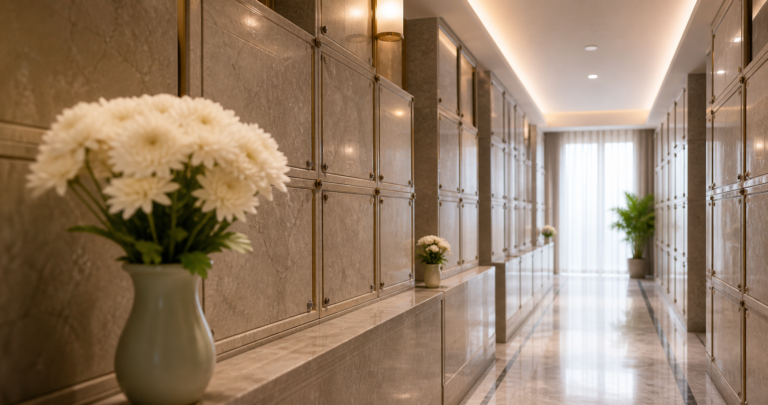
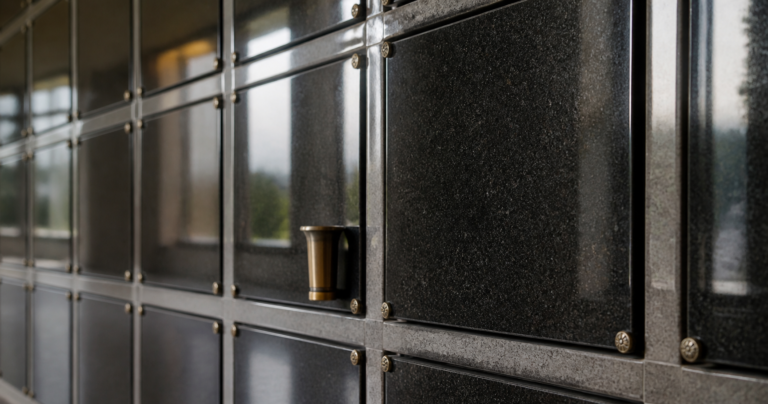
If the observance is held where the ashes are, check the facility’s visiting hours, which are not the same as its booking hours. Government niche booking runs Monday to Friday 8.30am to 4.30pm and Saturday 8.30am to 12.30pm, with a lunch closure from 1pm to 2pm and none on Sunday, but visiting access is a separate question worth confirming. Our guide to columbarium niches in Singapore covers the facilities.
If the ashes were scattered
Families who chose scattering at the Garden of Peace or at sea sometimes worry that they have left themselves nowhere to observe. An ancestral tablet solves this directly: it gives the observances a fixed location independent of where the remains went. Our ash disposition guide covers the options and this consequence of each.
How this follows from the funeral
The calendar starts the day of the death. If you are at the beginning of this rather than partway through, our pages on what to do when someone passes away in Singapore, the funeral process, the funeral wake, the cremation process and what happens after cremation cover the sequence in order. Costs are covered in funeral costs in Singapore and funeral packages, the urn in our urn guide, and provider choice in how to choose a funeral service. Where feng shui bears on dates, our page on feng shui in Singapore funerals covers it, and families dealing with an older burial should see the exhumation process and night exhumation rituals.
Speaking to someone
Nirvana Memorial Garden provides columbarium niches, ancestral tablets and prayer arrangements in Singapore alongside Buddhist, Taoist, Christian and Catholic funeral services. If you need help working out your family’s dates, or want the observances arranged rather than organised yourself, our team can help.
Call +65 6363 6363 or email contact@nirvanasingapore.sg.
The observances described here are religious and cultural practice, and vary between lineages, dialect traditions and temples. Government fees and rules referenced are as published by the National Environment Agency at the time of writing. Your own temple or priest is the authority on what your family should observe.