A Taoist funeral in Singapore runs to a structure that has changed little in generations: a wake held over an odd number of nights, scripture chanted by a Taoist priest, paper offerings burned for the deceased’s journey, and a procession to the crematorium on the final morning. Most families arranging one have never done it before, and they are working out the sequence while grieving, often within hours of a death.
This guide sets out what happens, in what order, which decisions fall to the family, and which costs are fixed by the government rather than by a funeral director. Where a figure is published by the National Environment Agency it is quoted here. Where no public figure exists, this guide says so instead of estimating.
What a Taoist funeral is for
Taoist funeral rites are built on the belief that the soul continues after death and must be guided through its passage. Almost everything in the ceremony serves that purpose. The chanting is directed at the soul, not at the mourners. The paper offerings are sent ahead. The odd number of nights, the continuously burning oil lamp and the order in which relatives kneel each carry a meaning that predates their Singaporean setting by centuries.
In practice, Taoist and Buddhist funeral customs overlap heavily in Singapore, and many Chinese families here observe elements of both without treating the distinction as a problem. If you are trying to work out which tradition your family follows, our guide to Buddhist and Taoist funeral services sets the two side by side. Where a family is unsure, the funeral director will usually ask which dialect group and which temple the family is associated with, because that answers the question faster than asking about doctrine.
How long a Taoist wake lasts
Three, five or seven nights
Taoist wakes in Singapore normally run for three, five or seven nights. The number is traditionally odd. Three nights is the most common choice today, for reasons that are partly practical: void deck permits and parlour halls are booked in daily blocks, and relatives travelling from overseas need a fixed date to plan around.
There is a hard ceiling. NEA requires prior written permission if a funeral wake extends beyond seven days after the death. Without embalming, a wake may be held only if the body is in a hermetically sealed coffin without a viewing window, and again only for a period not exceeding seven days after death. A seven-night wake is therefore at the outer edge of what is permitted rather than a free choice, and any longer needs an application to NEA’s Memorial Facilities and Planning Division.
Where the wake is held
Three venues account for nearly every Taoist wake in Singapore.
- An HDB void deck, still the most common setting and the least expensive. It requires a permit from the Town Council that manages the block.
- A funeral parlour, which provides an air-conditioned hall, on-site amenities and no permit application.
- The family home, which is unusual in Singapore given typical flat sizes, and which brings its own approvals if public roads or walkways are used.
The permits the venue decides
The venue, not the religion, determines the paperwork. A funeral director handles all of it, but families are entitled to know what is being applied for on their behalf.
| Wake location | Approval needed | Who grants it |
|---|---|---|
| Void deck, multi-purpose hall or pavilion | Permit | The managing Town Council |
| Adjacent surface car park lots | Application for non-parking use | HDB, via the managing branch or 1800-225-5432 |
| Private or landed property using public roads or walkways | Temporary Occupation Licence, and the prevailing TOL fee | Singapore Land Authority |
| State land | Temporary Occupation Licence, and the prevailing TOL fee | Singapore Land Authority |
| URA-managed parking lots | Prior approval before use | Urban Redevelopment Authority |
| Wake running beyond 7 days after death | Prior written permission | National Environment Agency |
For a TOL, applicants must comply with Land Transport Authority and Traffic Police requirements, but no separate application to those two agencies is needed.
The mourning hall
The ling tang set-up
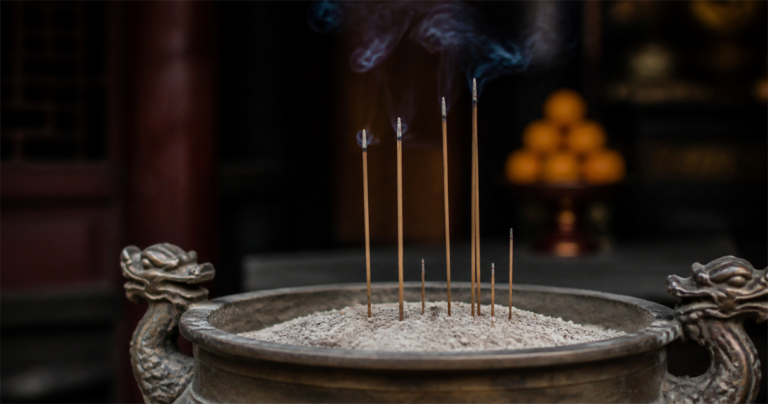
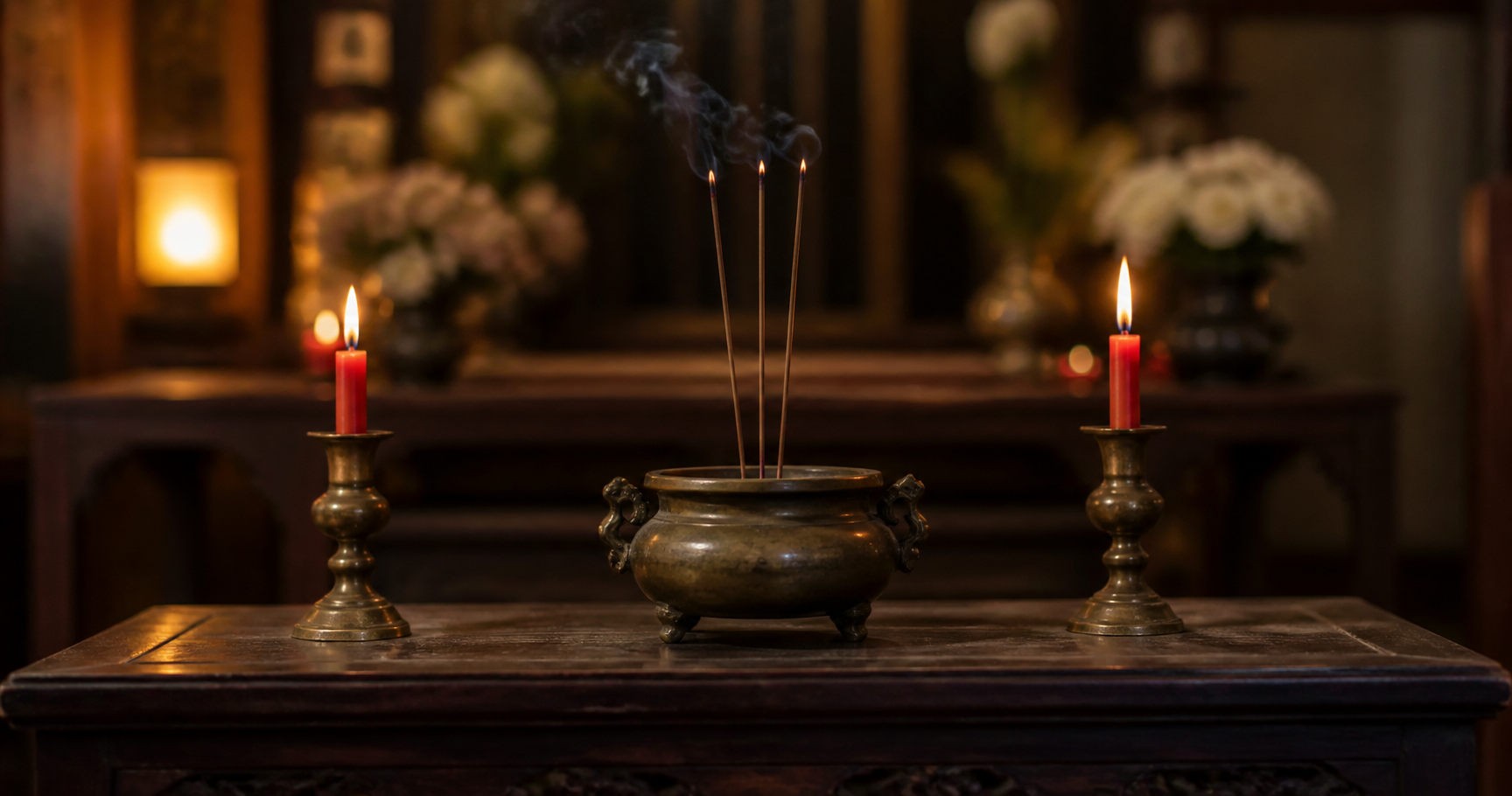
The casket rests in an arrangement called the ling tang, the mourning hall. A portrait of the deceased sits at the centre. An oil lamp is kept continuously lit. Offerings of food and fruit are placed before the portrait, and an incense urn stands where visitors pay their respects. The scale of the set-up is one of the main things that separates a modest funeral package from an elaborate one.
Mourning dress and what the colours mean
Immediate relatives wear mourning garments, and the colour and material traditionally indicate the mourner’s relationship to the deceased and their generation within the family. Children and children-in-law wear one grade, grandchildren another, and so on outward. Guests are not expected to wear mourning dress. They are expected to avoid red, and generally to wear dark or muted clothing.
Day by day: what actually happens
Encoffining
The body is washed, dressed and placed in the casket, usually on the first day. Some families choose to be present; others prefer not to be, and there is no expectation either way. Whether the body is embalmed depends on the arrangement chosen. Embalming replaces bodily fluids with formaldehyde-based solutions to delay decomposition, and it is necessary for a wake with viewing or an open casket. Funeral parlours with embalming facilities are licensed by NEA.
Nightly chanting
A Taoist priest leads scripture recitation to guide the soul through its passage. Family members kneel or stand behind the priest, and the chanting may run an hour or longer each evening. This is the ritual core of the funeral, and it is the component families most often ask to keep intact when trimming costs elsewhere.
Receiving visitors
Guests offer incense at the urn, bow to the portrait, and sit with the family. There is usually food, and often a table where visitors sign a book and leave condolence money in a white envelope. Nobody is expected to stay for the chanting unless they are family.
Paper offerings
Paper effigies, spirit money and sometimes paper models of houses, cars or household goods are burned so that their value passes to the deceased. This is the most visible feature of a Taoist funeral and the one most often misunderstood by those unfamiliar with it. The quantity and elaborateness of the offerings is a family decision and a significant cost variable.
Dialect differences that change the sequence
Taoist rites vary between lineages and between the dialect traditions represented in Singapore, so a Hokkien family and a Teochew family may follow noticeably different sequences with the same broad shape. This matters when relatives from different branches disagree about what is correct: often both are right, and they are following different traditions.
Hokkien
The largest Chinese dialect group in Singapore, and the tradition most Singaporean funeral directors handle by default. Expect a full priest-led sequence with substantial paper offerings.
Teochew
Broadly similar in shape, with differences in the chanting repertoire, the specific offerings and the order of some rites. Teochew families often engage priests from their own tradition rather than accepting whoever the parlour provides.
Cantonese and Hainanese
Smaller in number locally, with their own variations in mourning dress grades and in the timing of certain observances. If your family follows one of these traditions, say so when engaging a funeral director rather than assuming it will be asked.
The final morning
Sealing the casket
On the last day a short ceremony precedes the sealing of the casket. One practical warning applies regardless of tradition: if the deceased is to be cremated, any valuables placed in the coffin will not be recoverable afterwards.
The procession
The procession departs, usually early in the morning. The family follows the hearse on foot for part of the route before boarding vehicles. Families holding a wake at a void deck are asked to keep the disruption to neighbours contained, which in practice means directing attendees to designated parking and deploying traffic marshals where the road layout needs it.
At the crematorium
A final short service is held at the crematorium hall before the committal. Families who choose not to hold a wake at all, a direct cremation, often hold this service instead, either at home or at the crematorium hall. NEA recognises direct cremation and direct burial as legitimate choices, and some families hold the memorial after the cremation with the ashes present rather than the body.
Cremation or burial
Most Singaporean Taoist families now choose cremation. Land constraints are the main reason, and the burial policy is the other. If you are weighing the two, our comparison of cremation and burial in Singapore covers the practical and religious dimensions, and religious views on cremation addresses the question families most often raise with a priest.
What government cremation costs
There are four crematoria in Singapore: two government-managed and two private. NEA publishes the government fee, which makes this one of the few genuinely fixed numbers in a funeral.
| Facility | Cremation fee | Note |
|---|---|---|
| Mandai Crematorium / Mandai North Crematorium | $100 adult, $50 child under 10 | Government-managed |
| Kong Meng San Phor Kark See Monastery, 88 Bright Hill Road | $327, cremation only | Private. Inclusive of prevailing GST |
| Tse Tho Aum Temple, 601 Sin Ming Drive | $436, cremation only | Private. Inclusive of prevailing GST |
These are cremation fees alone. They do not include the casket, the priest, the wake, transport or the niche. Our full breakdown of the cremation process in Singapore sets out what happens on the day, and our cremation guide covers the arrangements around it.
What burial costs, and the 15-year rule
Choa Chu Kang Cemetery Complex is the only cemetery in Singapore still open for burials. For a Singapore citizen or permanent resident, burial at a government cemetery other than the Muslim, Ahmadiyya Jama’at, Jewish, Parsi and Bahai cemeteries is $940 for adults and children aged 10 and above, and $420 for children below 10.
The rule that shapes the decision is this: since 1 November 1998, the burial period for all graves has been limited to 15 years. At the end of 15 years the graves are exhumed. Where the religion permits cremation, the exhumed remains are cremated and stored in a columbarium niche. Choosing burial in Singapore therefore means choosing an exhumation for the next generation to handle, which is why our guides to why exhumation is required, the exhumation process, what an exhumation costs and how to apply for the NEA permit matter to families making the choice now. Taoist families in particular tend to ask about night exhumation rituals, which follow their own observances. The Choa Chu Kang cemetery burial guide covers the site itself.
Collecting the ashes
Where to collect and when
The family returns to collect the ashes, generally on a later date rather than the same day. Collection happens at an Ash Collection Centre, and the two have different hours.
| Ash Collection Centre | Address | Opening hours |
|---|---|---|
| Choa Chu Kang Crematorium | 960 Old Choa Chu Kang Road, Singapore 699818 | Mon-Fri 8.30am to 4.30pm, closed 1 to 2pm, closed weekends and public holidays |
| Mandai Crematorium | 300 Mandai Road, Singapore 779393 | Mon-Sun 8.30am to 4.30pm, closed 1 to 2pm |
The Choa Chu Kang weekend closure took effect on 1 February 2025 and catches families out, because the crematorium there operated differently before. Check the day before you travel.
Fine ashes for scattering
If the intention is to scatter, note that only fine ashes may be scattered at the government gardens. Cremated remains need processing into fine ashes first, and the collection centres above are where that is arranged.
Where the ashes go
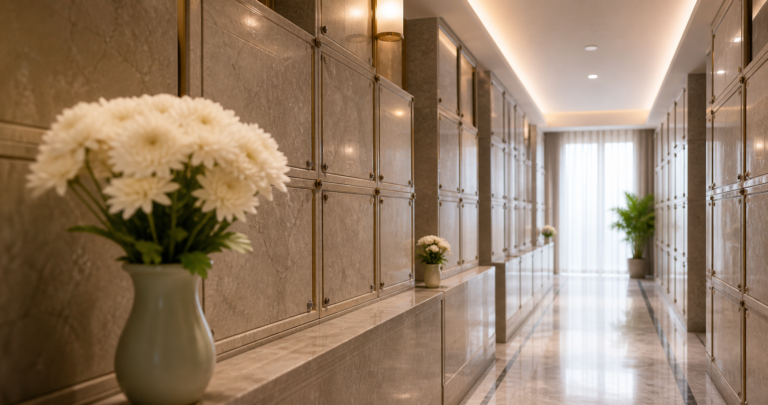
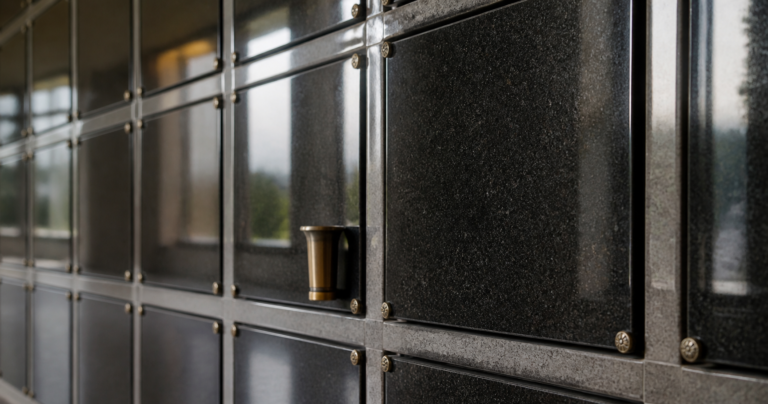
A columbarium niche
Most Taoist families place the ashes in a columbarium niche. Niches are available at two NEA-managed columbaria and at many private columbaria. At government columbaria a standard niche holding roughly two urns is $500 and a family niche holding roughly four urns is $900. Niches are allocated sequentially, and there is a $250 selection fee if you want to choose a different location from the one allocated. No advance booking is allowed, which means this is not a decision that can be settled before a death.
Our columbarium niche service page covers the private alternative, and what happens after cremation walks through the sequence from collection to placement.
Ash scattering
Two government options exist. Ashes may be scattered at sea at a site designated by the Maritime Port Authority about 3.2 km east of Raffles Lighthouse, daily from 7am to 7pm. Or they may be scattered at the Garden of Peace at Choa Chu Kang Cemetery, from 9am to 5pm daily, with a booking fee of $320 for the inland ash scattering service. Our ash disposition guide compares the options in full.
Keeping ashes at home
Ashes may also be kept at home. This is permitted, and some families do it, though it raises questions about what happens to the urn in the next generation that a niche or a tablet answers more durably.
Mourning after the funeral
Taoist mourning does not end when the wake does. Observances continue at intervals, and families frequently ask about these months later.
The seven seven-day cycles
Prayers are held every seventh day after the death, across seven cycles, so the forty-ninth day marks the last of them. The first and the seventh are the most widely observed.
The hundredth day
A memorial prayer at one hundred days, still widely kept in Singapore even by families who let the intermediate cycles pass.
The first anniversary
A further prayer service one year on, after which annual observance usually shifts to Qing Ming.
Qing Ming
The annual tomb-sweeping festival, when families visit graves and columbarium niches to clean them and make offerings. For families with a niche or an ancestral tablet, this becomes the permanent annual observance. Our pages on ancestor tablets and ancestral pedestals explain how the tablet fits into ongoing veneration.
Not every family keeps all of these. Some observe the forty-ninth and hundredth days and little else, and there is no single correct level of observance.
What a Taoist funeral costs
The fees that are fixed and published
A small part of the total is set by the government and identical for everyone: the cremation or burial fee, and the niche fee if a government columbarium is used. Those figures are in the tables above. They typically add up to a few hundred dollars.
The costs that vary
Everything else varies, and three choices drive most of the difference: the length of the wake, the venue, and the casket. A three-night void deck wake with a standard casket sits at the lower end. A seven-night parlour wake with an elaborate casket and extensive paper offerings sits considerably higher. The priest’s fee, the mourning hall set-up, transport and the crematorium booking usually come bundled into a package.
Comparing packages is genuinely difficult because inclusions differ between providers, which is why we published a full breakdown of funeral costs in Singapore and a guide to what funeral packages contain. We do not publish a single headline price for a Taoist funeral, because any number we printed would be wrong for most families reading it.
Questions to ask before signing
The Competition and Consumer Commission Singapore developed a checklist for exactly this moment, framed as A.S.K.: Ascertain the wishes of the deceased and the family, Seek clear answers from the provider so you know what you are paying for, and Know the sources you can check independently. It came out of a market study of funeral services in Singapore conducted with NEA’s support. Asking a provider to itemise a quote is normal, and a provider who resists is telling you something.
Taoist, Buddhist, or both
Many Singaporean Chinese families observe both traditions and do not experience that as a contradiction. Where the two diverge in practice, the priest and the funeral director will follow whichever the family names. If your family is comparing traditions, Singapore Buddhist funeral customs and the difference between Buddhist and Christian funerals cover the neighbouring cases, and the funeral blanket is one specific item families ask about repeatedly. Feng shui considerations, which sit alongside rather than inside Taoist rites, are covered in our page on feng shui in modern Singapore funerals.
What to do first if a death has just occurred
The funeral arrangements are not the first step. A doctor certifies the death, and under the current process that certification is submitted online to the Immigration and Checkpoints Authority, which is what produces the digital death certificate. The funeral director then applies for the Permit to Bury or Cremate and books the slot. Our page on what to do when someone passes away in Singapore sets out the sequence, and the funeral process covers what follows. Most families reach the funeral director stage within a day.
If a death is expected rather than sudden, deciding these things in advance removes almost all of the pressure. Our page on pre-planning covers what can be settled ahead of time, and what cannot. A niche, for instance, cannot be booked in advance at a government columbarium.
Speaking to someone
Nirvana Memorial Garden arranges Taoist funerals across Singapore, alongside Buddhist, Christian and Catholic services, and provides columbarium niches and ancestral tablets for the years afterwards. If you are comparing providers, our page on choosing a funeral service in Singapore sets out what to look for, including the independent checks worth running on anyone you speak to.
If you are arranging a funeral now, or planning ahead, our team can talk through the options without obligation. Call +65 6363 6363 or email contact@nirvanasingapore.sg.
Government fees, opening hours and permit requirements in this guide are as published by the National Environment Agency and the Maritime Port Authority at the time of writing. Fees change. Confirm current figures with NEA before relying on them.