Why Exhumation is Required in Singapore
When you lay a loved one to rest, you expect them to remain there forever. In Singapore, this isn’t the case. Graves here have an expiration date. After 15 years, every grave at the country’s only active cemetery is opened, and the remains are removed. This reality shocks many families who discover too late that their ancestors will be disinterred. Understanding why exhumation is required in Singapore is essential for anyone planning a burial or managing a family grave. This guide explains the policy, its religious accommodations, and exactly what happens when the 15-year mark arrives.
Introduction: The Expiration Date on Every Grave
Singapore’s prosperity came at a cost—land is our scarcest resource. With nearly 5.9 million people living on just 734 square kilometres, every plot must serve multiple generations. Since 1998, the government has required that all graves be exhumed after 15 years. This policy ensures that cemetery land can be reused sustainably. For families, this means planning not just for a funeral, but for a future transition that will come decades later.
The Fundamental Reason: Why Exhumation is Required in Singapore
Land Scarcity: The Core Driver
The primary reason why exhumation is required in Singapore is simple mathematics. Singapore faces a land constraint that few nations experience as acutely. With population density among the highest in the world, every square metre carries immense value and competing demands for housing, infrastructure, and green spaces. This fundamental reality has shaped the nation’s approach to burial grounds for decades.
The government introduced the new burial policy in Singapore in 1998 specifically to combat land scarcity. This policy limits the burial period to 15 years for all graves at Choa Chu Kang Cemetery, which is now Singapore’s only active burial ground. After this period, graves are exhumed in phases to free up land for future use.
When families understand what to do when someone passes away in Singapore , they can make more informed decisions about burial versus cremation from the outset. This initial choice has profound implications for what happens 15 years later. Understanding the complete funeral process in Singapore helps families see how the 15-year rule fits into the broader journey from death certification to final disposition.
The Crypt Burial System: Optimising Limited Space
To make the most of available land, the National Environment Agency (NEA) introduced the Crypt Burial System (CBS) in 2007. This innovative approach improves upon traditional soil burial by using concrete crypts without bases, laid out in efficient grids.
The CBS offers several advantages that address why exhumation is required in Singapore from a practical standpoint:
- Prevents grave shifting: Unlike soil burials, crypts prevent underground movement and erosion that can cause graves to shift over time
- Neater layout: Crypts arranged in grids create organised, accessible burial grounds
- Long-lasting: The concrete structure ensures burial sites remain intact for years
- Higher density: Multiple remains can be placed in a single crypt, optimising land use
The system has been endorsed by various religious bodies, including the Islamic Religious Council of Singapore (MUIS), the Singapore Buddhist Federation, the Catholic Archdiocese of Singapore, and the Hindu Endowments Board. This broad acceptance ensures that the policy respects diverse faith requirements while achieving its land optimisation goals.
How the Exhumation Process Works
Understanding the mechanics of exhumation helps families prepare for what happens when the 15-year burial period ends. Knowing how to arrange a funeral in Singapore for the exhumation process is similar to arranging an initial funeral, with many of the same considerations around religious rites and family preferences.
Phased Exhumation Programmes
NEA carries out exhumation programmes in phases at Choa Chu Kang Cemetery. This staggered approach allows for systematic management of thousands of graves. The government announces these phases well in advance, providing families time to prepare.
For Muslim cemeteries specifically, MUIS alerts next-of-kin through comprehensive channels during the one-year claim registration period:
- Newspaper notices
- Signboards at the affected burial blocks
- Banners, pamphlets, and posters at mosques
- Radio and mosque announcements
- Updates on MUIS Facebook and the official exhumation website
Who Can Claim Remains
Family members are eligible to claim the remains of their next-of-kin. Legally adopted children are recognised as immediate family members and may make decisions about burial and exhumation of their adoptive parents, in accordance with Singapore law, including for Muslims.
If you are not a family member, you are not permitted to claim the deceased’s remains unless authorised by the deceased’s direct living family member via written authorisation.
Required Documentation
To claim remains during an exhumation exercise, family members must prepare:
- Claimant’s NRIC
- A copy of the Death or Burial Certificate (for Supplementary Graves only)
- Written authorisation from biological family members, where applicable (for Principal Graves only)
- Supporting documents, including legal documentation for adopted children, where applicable
To obtain a burial location search, families can contact NEA’s Choa Chu Kang Cemetery Office at 6795 9731 by providing the deceased’s information, such as name, date or year of death, and prominent landmarks near the cemetery block.
Registration Methods
From Tuesday, 10 June 2025, claimants may register via two methods:
- Online Registration: Claimants can register online using Singpass via pusara.sg
- Physical Registration: Claimants who are unable to register online may make appointments via the website to visit the Muslim Cemetery Exhumation Office (MCEO)
Registration typically closes one year after opening. Importantly, registering early does not secure an earlier exhumation date, as exhumation schedules are determined by operational needs.
What Happens During Exhumation
The exhumation process itself follows strict protocols to ensure dignity and respect.
Physical Exhumation Procedures
Professional exhumation teams follow established procedures:
- The grave is opened to the original soil depth (liang lahad) to retrieve any remains
- Any remains found are handled with care and documented
- Personal effects and burial items may be collected
- If no remains are found, a token amount of grave soil is collected for reinterment
- The site is restored and prepared for future use
Witnessing the Exhumation
Claimants and relatives may witness the exhumation, either fully or partially. If unable to attend, claimants may authorise other family members or MUIS to act on their behalf through a written authorisation. For any changes, families should notify MUIS at least two weeks before the scheduled exhumation.
Shrouding and Religious Considerations
For Muslim graves, the remains are brought to the Shrouding Station located at Block N-1-15 (Pusara Abadi). Claimants must present their Sticker Label, provided on the exhumation day, to witness the shrouding process.
Importantly, no special prayers, such as Talkin (brief reminder), are conducted for the exhumed remains, as there is no religious requirement. This guidance comes from MUIS, ensuring that Islamic practices are properly observed.
What Happens to Exhumed Remains
After exhumation, remains are handled according to religious requirements and family preferences. Understanding religious views on cremation in Singapore helps families navigate these sensitive decisions with confidence.
For Claimed Graves
When families claim remains, they have two main options depending on their faith:
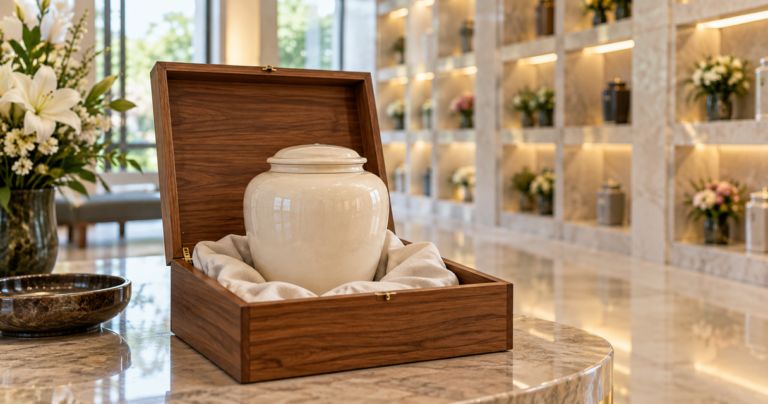
Cremation and Columbarium Placement: For families whose religions permit cremation, this is the most common path. The remains are cremated and placed in an urn within a columbarium. Government columbarium niches range from $500 to $1,800 depending on location and lease duration. Knowing what happens after cremation in Singapore helps families understand the full cycle, from cremation to ash collection and final memorialisation.
Re-interment in Crypts: For religions that mandate burial, such as Islam, remains are re-interred in the Crypt Burial System. According to NEA guidelines:
- Up to 8 remains per crypt for claimed graves
- Up to 16 remains per crypt for unclaimed graves
These numbers are subject to the sizes of the remains. Importantly, no reservations of positions in the crypt or selection of crypt location are allowed. Any vacant positions will be filled with remains claimed by other family members of the deceased.
When selecting services for post-exhumation arrangements, families can explore various funeral packages in Singapore that cater to specific religious requirements. The choice between affordable vs premium funeral packages in Singapore allows families to balance their budget with their desire for a meaningful ceremony.
For Unclaimed Graves
When families cannot be located or do not come forward during the registration period, graves are classified as “unclaimed.” These graves are still exhumed according to schedule:
- Unclaimed graves are exhumed and the remains reinterred at Choa Chu Kang Muslim Cemetery
- The exhumation process is supervised by MUIS
- NEA maintains all reinterment records in their database
- Up to 16 remains may be placed in a single crypt
Reinterment Documentation
Following exhumation and reinterment, claimants receive a reinterment document from MUIS detailing the new grave block and plot numbers. NEA maintains all reinterment records in their database, ensuring that information remains accessible even for unclaimed graves.
Religious Perspectives on Exhumation
Singapore’s multicultural society means that the policy on why exhumation is required in Singapore must accommodate diverse religious views. Extensive consultations with religious leaders have shaped how exhumation is implemented.
Islamic Perspectives
Islam requires burial and emphasises treating the deceased with utmost respect. MUIS has addressed this through a formal fatwa (religious ruling).
The 1970 Fatwa on Exhumation: The Fatwa Committee of the Islamic Religious Council of Singapore issued a ruling on 5 March 1970 addressing whether Muslim graves on government land could be exhumed.
The fatwa determined that Muslim graves on government land can be exhumed and the deceased’s remains reinterred if the land holds a Temporary Occupation License (T.O.L) and if the request is put forth by the government.
For Muslim graves on wakaf land, exhumation is not allowed unless the bodies have completely decayed, or there is a general benefit for the Muslim community and the graves are located in a Muslim country. Any exhumation must protect the dignity of the deceased, with remains wrapped in clean cloth and reburied in another burial ground.
This fatwa provides the religious foundation for Muslim participation in Singapore’s exhumation programme, ensuring compliance with Islamic law while addressing practical land constraints. Muslim families should also understand the cremation vs burial in Singapore distinction, as Islam prohibits cremation entirely.
Buddhist and Taoist Perspectives
For Buddhist and Taoist families, exhumation followed by cremation aligns with teachings on impermanence. Monks or priests may conduct chanting and rituals during the exhumation process. The Singapore Buddhist Federation and Taoist Federation have endorsed the Crypt Burial System, indicating acceptance of these practices. For those who choose cremation, understanding the cremation process in Singapore helps ensure that religious requirements are properly observed.
Christian Perspectives
Most Christian denominations in Singapore accept cremation as compatible with beliefs about resurrection and eternal life. The Catholic Archdiocese of Singapore and the National Council of Churches of Singapore have supported the Crypt Burial System, demonstrating that exhumation and reinterment can be conducted respectfully.
Hindu Perspectives
Hinduism embraces cremation as the traditional method for handling deceased bodies. The soul (atman) is eternal and separate from the body, which is seen as a temporary vessel. The Hindu Endowments Board’s support for the Crypt Burial System indicates acceptance of these exhumation practices.
Costs Associated with Exhumation
Understanding the financial aspects of exhumation helps families plan effectively. The cost of funeral services in Singapore provides context for these expenses.
Government-Borne Costs
For affected graves (Principal Graves) in designated exhumation blocks, there is no fee for the exhumation of affected graves. The government bears all exhumation and reinterment costs for these graves.
Family-Borne Costs
Families may incur costs in certain situations:
- Supplementary Grave Registration: For each registration of a Supplementary Grave (graves outside affected blocks that meet the 15-year requirement), a non-refundable fee of $80 (before GST) per grave is charged
- Burial Extract: To obtain a burial extract from NEA’s Choa Chu Kang Cemetery Office, the fee is $20 (after GST)
- Cremation Services: If families choose cremation of exhumed remains, government cremation fees apply (approximately $100-$315)
- Columbarium Niches: Government niches range from $500-$1,800; private options cost more
Handling Disputes and Objections
Family disagreements can arise during the exhumation process. The system provides mechanisms to address these situations.
For Principal Graves
If family members submit a written objection to MUIS and cannot resolve the disagreement, the grave will be marked as unclaimed and exhumed in the unclaimed phase. This ensures that disputes do not indefinitely delay the exhumation programme.
For Supplementary Graves
Should any family member submit a written objection to MUIS regarding the registration or exhumation of a Supplementary Grave, the registration will be cancelled, and the exhumation will not proceed. This gives families more control over non-mandatory exhumations.
Changing the Claimant
It is possible to change the main claimant. Both the current claimant and the next-of-kin must mutually agree to the change through written authorisation, accompanied by copies of their respective NRICs. Claimants must make this request at the Muslim Cemetery Exhumation Office before the registration closing date.
Decorating Reinterment Crypts
Families wishing to decorate reinterment crypts must follow specific guidelines:
- No permanent or obstructive structures, such as cement or fences, are allowed
- Any form of decorations or structures outside the grave plot is prohibited, and will be removed if erected
- If there is a dispute among claimants of the shared reinterment crypt due to a lack of consensus, NEA will first assist in mediation
- If mediation fails, all decorations must be removed immediately
Notably, you are not required to seek permission from other claimants sharing the crypt.
Safety Guidelines for Cemetery Visits
When visiting Choa Chu Kang Cemetery, whether for a fresh burial or to prepare for exhumation, follow these safety guidelines, as advised by the National Parks Board:
- Visit during daytime and avoid adverse weather
- Take shelter at nearby pavilions and vehicles during Category 1 Lightning
- Keep a safe distance and move slowly away when encountering wild animals (wild dogs, wild boars, snakes, bees, hornets, spiders, mosquitoes, fire ants)
- Exercise care and caution when navigating within the cemetery compound
- Bring weather protection (umbrellas, hats, sunglasses) and wear protective footwear
- Read prominent signages of NEA’s Rules and Regulations within the cemetery
Important Warning About Third-Party Services
Third-party grave maintenance service providers are not regulated or endorsed by NEA. Next-of-kin who have not made prior private arrangements for such services are advised not to pay anyone who claims to have maintained the graves of their loved ones.
These third-party providers are not to engage in any illegal activities, such as touting, extortion, harassment, and cheating. Visitors may lodge a police report should you encounter any such incident.
The Human Dimension: Stories Behind the Policy
The policy on why exhumation is required in Singapore affects real families with deep emotional connections to their ancestors. A 2016 Straits Times article highlighted one such story.
Ms Jean Yeo and her uncle, Mr Donald Yeo, battled to save the graves of 10 of their ancestors in Choa Chu Kang Cemetery, which were slated for exhumation in August of that year. The graves included a mass grave housing four relatives, including Tan Ja Dee Neo who once owned a park in Singapore.
Ms Yeo, who was battling Stage 3 colorectal cancer and brain cancer at the time, said it was her “dying wish” that her ancestors’ graves remain intact. The mass grave was flanked by statues of four Sikh guards and Chinese warriors, which tomb expert Raymond Goh described as reflecting Singapore’s “melting pot of cultures.”
This story illustrates the emotional weight that exhumation carries for families. While the policy serves important national interests, it also touches on profound questions of heritage, memory, and belonging.
Academic Perspectives on Exhumation in Singapore
The practice of exhumation in Singapore has drawn scholarly attention. Anthropologist Ruth E. Toulson’s book “Necropolitics of the Ordinary: Death and Grieving in Contemporary Singapore” examines how government policies on cemeteries affect families and cultural practices.
Toulson documents what she describes as “a revolution in the way death is ritualized and grieved” in Singapore. Confronted with high population density and rapid economic growth, the government has ordered the destruction of every burial ground but one, forcing families to exhume the remains of ancestors.
The book explores how, in a context where the dead remain central to family life, forced exhumation tears the social fabric, turning ancestors into ghosts. Using death ritual and grieving as lenses, Toulson examines the scope of and resistance to state power over the dead.
This academic work underscores that understanding why exhumation is required in Singapore involves not just policy analysis but also consideration of cultural and emotional dimensions.
Practical Advice for Families
If You Have a Loved One Buried at Choa Chu Kang Cemetery
- Confirm the burial date and location: Contact NEA’s Choa Chu Kang Cemetery Office at 6795 9731 with the deceased’s information
- Watch for official notifications: Pay attention to newspaper notices, cemetery signboards, and for Muslim graves, mosque announcements and MUIS channels
- Register during the claim period: Come forward during the one-year registration period
- Discuss preferences with family: Ensure consensus on post-exhumation arrangements
- Prepare documentation: Gather NRICs, death or burial certificates, and any authorisation letters
Questions to Discuss with Family
- Do we know when the 15-year burial period expires?
- What are our religious requirements regarding cremation versus re-interment?
- Who will be responsible for registering the claim?
- Do we prefer a columbarium niche, and if so, which location?
- How will we share any costs among family members?
Conclusion: Balancing Respect and Sustainability
Understanding why exhumation is required in Singapore reveals a carefully considered policy that balances multiple imperatives: the finite reality of land, respect for diverse religious traditions, and the emotional needs of grieving families.
The 15-year burial limit, implemented through phased exhumation programmes and supported by the Crypt Burial System, ensures that Singapore’s limited cemetery land can serve future generations. Religious accommodations, developed through consultation with faith leaders including MUIS’s fatwa on exhumation, demonstrate that policy can respect tradition while addressing practical constraints.
For families, the key takeaways are clear:
- Exhumation is not optional—it applies to all graves at Choa Chu Kang Cemetery after 15 years
- Notification and registration are critical—stay informed about exhumation phases and register during the designated period
- Religious accommodations exist—the policy respects diverse faith requirements, with specific provisions for Muslim, Buddhist, Christian, Hindu, and other communities
- Post-exhumation options depend on faith—remains may be cremated for columbarium placement or re-interred in crypts
- Plan ahead—discuss preferences with family, prepare documentation, and understand the timeline
For the most current information on exhumation programmes, always refer to official sources: the National Environment Agency website, the Singapore Statutes Online for legal regulations, for Muslim burials, the official pusara.sg portal, or for religious guidance, the Majlis Ugama Islam Singapura (MUIS) website.
By understanding why exhumation is required in Singapore, families can participate in a system that serves both present and future generations, ensuring that every loved one receives the dignified farewell they deserve while respecting the nation’s fundamental land constraints.