An urn is the container that holds cremated ashes. In Singapore it is one of the few decisions in a funeral that a family makes calmly, days after the cremation rather than hours after a death, and it is also one of the few where the constraint is physical rather than ceremonial: the urn has to fit the niche it is going into.
That single fact is the most useful thing to know before shopping, and it is the thing least often mentioned. This guide covers the materials, the sizes, where the urn goes, and how urn cost actually works in Singapore, which is not the way the search results suggest. Government fees quoted here are published by the National Environment Agency. Urn prices are not government-set, and no figure is invented here to fill the gap.
First, the order of events
The urn decision sits at a specific point in the sequence, and families sometimes try to make it too early.
- The death is certified, and the funeral director applies for the Permit to Cremate
- The wake is held, if the family is holding one
- The cremation takes place
- The ashes are collected, on a later date rather than the same day
- The urn is chosen and the ashes are placed in it
- The urn goes into a niche, or the ashes are scattered, or the urn is kept at home
Steps five and six are linked, which is why the destination should be settled before the container. Our guide to the cremation process in Singapore covers steps one to three, and what happens after cremation covers four onwards.
Where the ashes are collected
Collection happens at an Ash Collection Centre, and the two have different opening hours. The Choa Chu Kang closure at weekends took effect on 1 February 2025 and still catches families out.
| Ash Collection Centre | Address | Opening hours |
|---|---|---|
| Choa Chu Kang Crematorium | 960 Old Choa Chu Kang Road, Singapore 699818 | Mon-Fri 8.30am to 4.30pm, closed 1 to 2pm. Closed Saturdays, Sundays and public holidays |
| Mandai Crematorium | 300 Mandai Road, Singapore 779393 | Mon-Sun 8.30am to 4.30pm, closed 1 to 2pm |
The constraint nobody mentions: the niche decides the urn
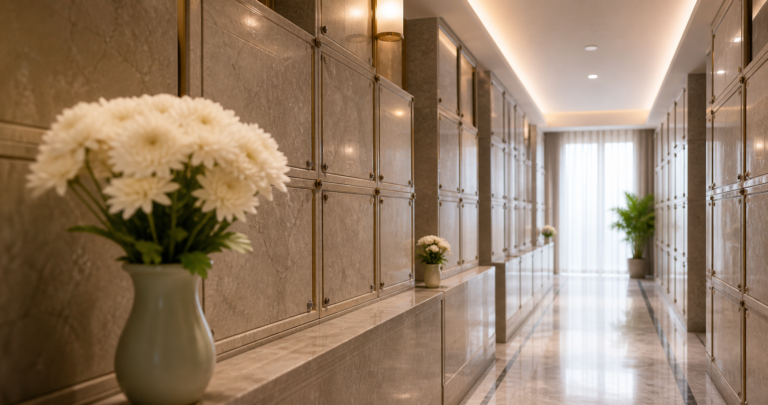
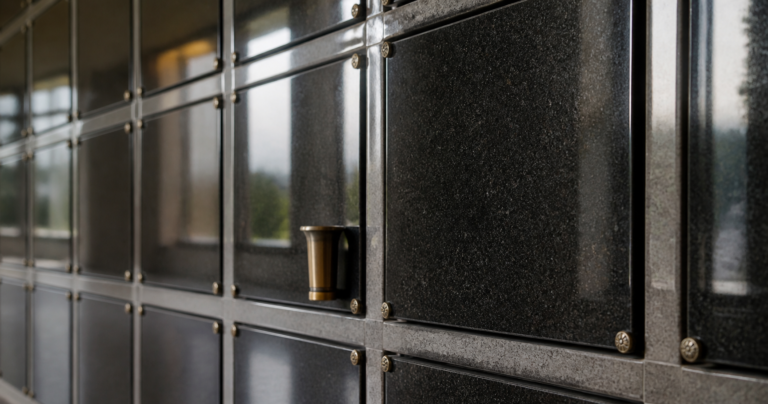
At government columbaria a standard niche holds around two urns and a family niche around four. The compartment has fixed internal dimensions. An urn that is beautiful and slightly too tall is a problem discovered at the worst possible moment.
Ask the columbarium for the internal dimensions of the niche before buying, and buy to those. Private columbaria differ from government ones and from each other. If the intention is to place two urns in one standard niche, so that a couple is together, the two urns together have to fit, which usually rules out the larger decorative styles. Our guide to columbarium niches in Singapore covers the niche side, including the fee schedule and the booking rules.
What to bring to the niche booking
The urn and the niche are booked in the same window, and the paperwork belongs to the niche rather than the urn. NEA requires the following to book a niche at a government columbarium, and having it assembled before the trip saves a second one.
- The deceased’s details, evidenced by the digital death certificate, a stillbirth certificate, or a hospital memo in the case of a foetus
- The Application for Cremation at an NEA-managed crematorium, or the Cremation Permit if a private crematorium was used
- Proof of identity of the applicant, such as NRIC or passport
- A Letter of Authorisation, if the applicant is not a next-of-kin
- A Letter of Undertaking, where applicable
Payment is due when the booking is confirmed, by NETS, Cash Card over the counter, or credit card. Government niche booking runs Monday to Friday 8.30am to 4.30pm and Saturday 8.30am to 12.30pm, with a lunch closure from 1pm to 2pm and no booking on Sundays. Bookings can be made through the NEA ePortal or in person at the service counters.
One rule shapes the whole decision: no advance booking of niches is allowed at government columbaria, and niches are allocated sequentially. You cannot reserve a location before a death, and you take the next one in the sequence unless you pay the $250 selection fee. Families who want a specific position, or want a couple placed side by side with certainty, generally look at a private columbarium for that reason. Our pre-planning page covers what can and cannot be settled in advance.
Two urns, one niche
Why families try it
Placing a couple together is one of the most common wishes families express, and a standard niche holding around two urns is the obvious way to do it. It usually works. The failure mode is buying the second urn years after the first, to a different design, and finding the pair no longer fits.
How to avoid the problem
If a second placement is anticipated, record the first urn’s exact dimensions and the niche’s internal dimensions at the time of the first placement, and keep that note with the family’s records rather than in someone’s memory. Buying a matched pair at the outset is the other approach, and some families do exactly that.
When a family niche is the better answer
Where three or four placements are genuinely anticipated, the family niche at $900 removes the geometry problem altogether and keeps the family in one location for Qing Ming. That convenience is worth more than the price difference to most families who have tried to visit two scattered niches in one morning.
Urn materials
Ceramic and porcelain
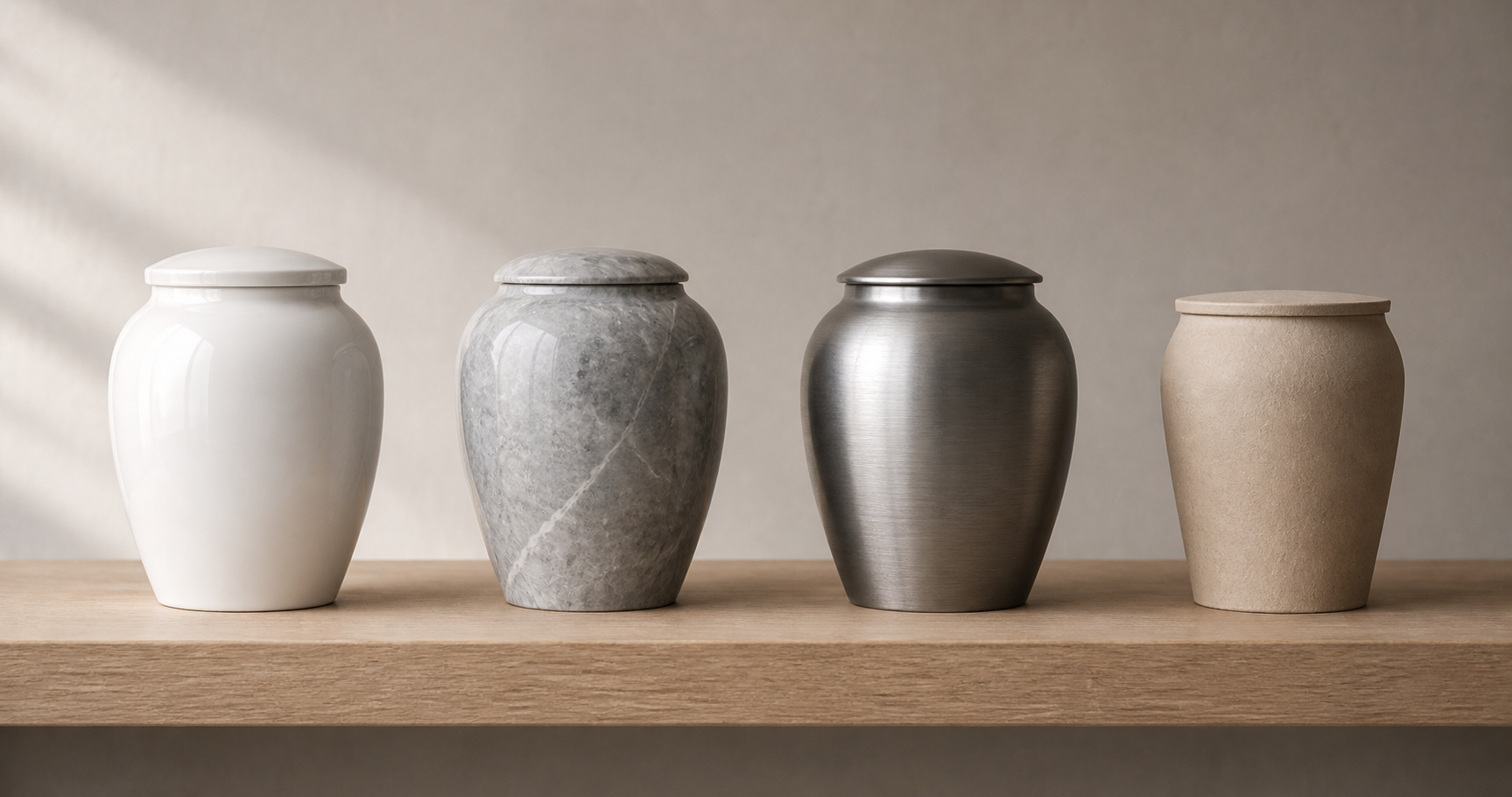
The most common choice for Singaporean Chinese families. Ceramic takes glazing and painted detail well, which is why most traditional designs are ceramic, and it sits comfortably in a columbarium environment. It is also breakable, which matters during transport rather than after placement.
Marble and stone
Heavy, durable and usually more expensive. Stone urns suit families who want the container to visibly match the permanence of the placement. The weight is a genuine consideration if elderly relatives will be carrying it during the placement ceremony.
Metal
Brass, bronze and stainless steel. Durable, sealed well, and generally the choice where the urn may be transported, including overseas. Metal urns are the usual recommendation when ashes are being repatriated.
Wood
Less common in Singapore’s climate than in temperate countries, because humidity is unkind to wood over decades in a naturally ventilated columbarium. Worth asking the facility about if you want one.
Biodegradable
Made for scattering or for burial of the urn itself rather than for a niche. If the family intends to scatter, note the rule in the next section before choosing one.
If the plan is scattering rather than a niche
Two government options exist in Singapore, and one rule governs both.
Only fine ashes may be scattered
NEA is explicit that only fine ashes are to be scattered at the gardens. Cremated remains are not automatically fine ashes; they need processing first, and the Ash Collection Centres listed above are where that is arranged. Families who skip this step arrive at a booked session unable to proceed.
Ash scattering at sea
The Maritime Port Authority has designated a site about 3.2 km east of Raffles Lighthouse for scattering at sea, available daily from 7am to 7pm. The MPA’s Port Marine Safety Control Centre can be reached at 6325 2488.
Inland ash scattering
The Garden of Peace at Choa Chu Kang Cemetery accepts scattering from 9am to 5pm daily. The booking fee for the inland ash scattering service is $320, payable at the service counters before the service, by NETS, Cash Card or credit card. Booking is through the NEA ePortal or in person at the Mandai Crematorium Office or the Choa Chu Kang Cemetery Office.
One point worth knowing before choosing this option: NEA conducts periodic ash soil transfer at the Garden of Peace and the Garden of Serenity, moving accumulated ash soil to a designated location within the Garden of Peace so the lanes remain available for continued use. Our ash disposition guide compares scattering against a niche in full.
What an urn costs in Singapore
Why there is no published price
NEA publishes fees for cremation, burial, niches and inland ash scattering. It does not publish an urn price, because urns are supplied by funeral directors, memorial parks and retailers rather than by the government. There is no regulated figure, and any single number quoted as “the” urn price in Singapore is a marketing number rather than a fact.
What actually drives the price
In rough order of effect: the material, the size, whether the design is a standard line or made to order, and whether the urn is bought as part of a funeral package or separately. Metal and stone sit above ceramic. Made-to-order sits above standard. Bundled sits below separate, usually, but only because the bundle absorbs the margin elsewhere.
The fees around the urn that are fixed
These are the published government figures the urn sits alongside, and they are worth having in view because they are often smaller than families expect.
| Item | Published fee |
|---|---|
| Cremation, government crematorium, adult | $100 |
| Cremation, government crematorium, child under 10 | $50 |
| Cremation, Kong Meng San Phor Kark See Monastery | $327, cremation only, inclusive of GST |
| Cremation, Tse Tho Aum Temple | $436, cremation only, inclusive of GST |
| Standard niche, government columbarium | $500 |
| Family niche, government columbarium | $900 |
| Niche selection fee, if not accepting sequential allocation | $250 |
| Inland ash scattering booking fee | $320 |
Asking for the urn to be itemised
The Competition and Consumer Commission Singapore’s A.S.K. checklist, developed with NEA’s support out of a market study of Singapore funeral services, exists for this. Its middle term is the operative one: seek clear answers so you know what you are paying for. An itemised quote showing the urn as a separate line is a reasonable request. Our breakdown of funeral costs in Singapore and of what funeral packages include set out where the urn usually sits in a quote.
Keeping an urn at home
It is permitted
NEA states that ashes may be stored at home as an alternative to a columbarium. Families do this, and there is no application to make.
The question it leaves open
What happens to the urn in the generation after the one that decided. This is the argument usually made for a niche or a tablet instead: both create an institutional record that outlives a household. Families who keep an urn at home and want that continuity often pair it with an ancestral tablet at a temple, which gives the veneration a fixed public location. Our pages on ancestral tablets in Singapore and ancestral pedestals cover that, and our tablet service page covers placement.
Practical care
A sealed urn in a stable indoor position needs nothing. Direct sun, damp and a position where it can be knocked are the three things to avoid, and they are the reasons ceramic urns kept at home are more often damaged than ceramic urns in a niche.
Religion and the urn
Buddhist and Taoist families
The urn and niche route is mainstream, with the tablet handling ongoing veneration. Our Buddhist and Taoist funeral guide, Singapore Buddhist funeral customs and Taoist funerals in Singapore cover the rites that precede it, and the funeral blanket is one item families ask about repeatedly.
Christian and Catholic families
Cremation is accepted by most denominations in Singapore. Religious views on cremation in Singapore sets out where each stands, and the difference between Buddhist and Christian funerals covers the comparison families in mixed households need.
Feng shui
Material, colour and placement orientation are all subjects a geomancer may be consulted on. This sits alongside the religious rites rather than inside them, and our page on feng shui in Singapore funerals covers the distinction.
If burial was chosen instead of cremation
An urn still enters the picture eventually. Choa Chu Kang Cemetery Complex is the only cemetery in Singapore open for burials, and since 1 November 1998 the burial period for all graves has been limited to 15 years, after which graves are exhumed. Where the religion permits cremation, the exhumed remains are cremated and stored in a columbarium niche, which means an urn.
Burial fees at government cemeteries for a citizen or permanent resident are $940 for adults and children aged 10 and above and $420 for children below 10, other than at the Muslim, Ahmadiyya Jama’at, Jewish, Parsi and Bahai cemeteries, where the fee is $315 and $140. Our pages on cremation compared with burial, the Choa Chu Kang burial guide, why exhumation is required, the exhumation process and exhumation costs cover the full arc.
One warning about the coffin
NEA notes it plainly: if the deceased is to be cremated, any valuables placed in the coffin will not be recoverable afterwards. Families who intend jewellery or keepsakes to survive into the urn need to remove them before the casket is sealed, not after. This gets missed in the compression of the final morning, and it is not reversible.
How the urn decision fits everything else
The urn is late in a sequence that starts at the moment of death. What to do when someone passes away in Singapore covers the first hours, the funeral process covers the days after, choosing a funeral service covers the provider decision, and our advance planning checklist covers what can usefully be decided before any of it is urgent.
Speaking to someone
Nirvana Memorial Garden provides urns, columbarium niches and ancestral tablets in Singapore alongside Buddhist, Taoist, Christian and Catholic funeral services. If you need to know what will fit a particular niche, or want to see urns in person before deciding, our team can help.
Call +65 6363 6363 or email contact@nirvanasingapore.sg.
Government fees, opening hours and scattering rules in this guide are as published by the National Environment Agency and the Maritime Port Authority at the time of writing. Urn pricing is not government-regulated. Fees change; confirm current figures with NEA before relying on them.