Why Cremation Is Increasing in Singapore: The Complete Guide
| Over 80% of deaths in Singapore now end in cremation. A decade ago, that number was lower. Families who once chose burial are switching. Land is running out. Costs are rising. Religious views are shifting. If you are planning a funeral or thinking about your own end-of-life arrangements, you need to understand what is driving this change and what it means for you. |
Burial has been part of Singapore culture for generations. But the city-state faces a specific set of pressures that make burial harder and cremation more practical. This article breaks down exactly why cremation is increasing in Singapore, what the data shows, and what your family should know before making a final decision.
Why Cremation Is Increasing in Singapore: The Numbers
Singapore does not have a large burial problem. It has a land problem. The country covers 733 square kilometres. Over 5.9 million people live here. Every square metre serves a purpose. Burial plots take up space permanently. Cremation does not.
The shift toward cremation has been steady and measurable.
| Year | Cremation Rate (Approx.) | Context |
| 1980s | ~40% | Burial still dominant; land policy less restrictive |
| 1990s | ~55% | Government introduces burial plot restrictions |
| 2000s | ~65% | NEA formalises burial period and exhumation rules |
| 2010s | ~75% | Land scarcity accelerates the shift |
| 2020s | ~80%+ | Cremation now the clear majority choice |
These numbers reflect a deliberate shift, not just a trend. Policy, land supply, and changing attitudes have all played a role.
The Land Constraint: Singapore’s Core Driver
Ask any funeral director in Singapore why cremation is increasing, and they will tell you the same thing. Land. Singapore has very little of it and a great deal of demand for it.
Burial Plots Are Not Permanent in Singapore
Unlike many countries where families purchase a burial plot in perpetuity, Singapore operates under a fixed burial period in Singapore. Most burial plots are granted for 15 years. After that period ends, the land is reclaimed.
This matters because families who choose burial must confront exhumation later. The new burial policy in Singapore outlines what happens when the period expires. Families must either apply for an extension or proceed with exhumation.
Exhumation Adds Complexity and Cost
When a burial period ends, exhumation is required in Singapore. The family must apply for a permit from the National Environment Agency (NEA), engage a licensed exhumation contractor, and decide what to do with the remains.
This is not a simple process. It involves paperwork, scheduling, fees, and emotional weight. Many families choose cremation specifically to avoid putting future generations through this experience.
Understand the full sequence by reading about what happens after the burial period ends and the grave exhumation and relocation process in Singapore.
Key Land Policy Facts:
|
Cost Is a Major Reason Why Cremation Is Increasing in Singapore
Funeral costs in Singapore are not cheap. But cremation is consistently less expensive than burial, especially when you factor in long-term costs.
| Cost Component | Cremation (SGD) | Burial (SGD) |
| Basic service / package | $1,200 – $5,000 | $3,000 – $10,000 |
| Plot or niche | $1,500 – $10,000 (niche) | $5,000 – $20,000+ (plot) |
| Annual maintenance | Minimal | $100 – $500+ per year |
| Exhumation (if burial) | N/A | $2,000 – $8,000+ |
| Long-term total (15 years) | $3,000 – $18,000 | $12,000 – $40,000+ |
These figures vary based on the provider and choices made. For detailed current pricing, review the cost of funeral services in Singapore.
Cremation removes the long-term costs of plot maintenance and eventual exhumation. That makes it more predictable and manageable for families at all income levels. You can compare affordable vs premium funeral packages in Singapore to see how options vary.
Changing Religious Views on Cremation in Singapore
Religion shapes funeral decisions more than almost any other factor. For decades, certain faiths in Singapore discouraged or prohibited cremation. That picture has changed.
Buddhism and Taoism
Buddhist and Taoist communities make up a large portion of Singapore’s population. Both traditions have historically accepted cremation. In fact, cremation is often the preferred choice within these communities. The practice of returning the body to the elements aligns with core beliefs about impermanence and rebirth.
Christianity
Christian denominations vary in their stance. Many Protestant and Catholic communities now accept cremation. The Catholic Church reversed its official prohibition in 1963. Today, most Christian families in Singapore choose based on personal preference rather than religious directive.
Hinduism
Hinduism traditionally favours cremation. For Hindu families in Singapore, cremation is not a trend. It has always been the standard practice. The rites performed before and during cremation are specific and carry deep spiritual meaning.
Islam
Islam is the one major religion in Singapore that requires burial. Muslim families follow specific rites that mandate burying the deceased intact. This is a firm religious obligation, and cremation is not an option for practising Muslim families.
Secular Families
A growing segment of Singapore’s population identifies as non-religious or secular. For these families, practical factors drive the decision. Cremation wins on cost, simplicity, and flexibility.
For a deeper understanding, read the full guide on religious views on cremation in Singapore, which covers how each faith community approaches the decision.
| Religion / Community | Cremation Stance | Burial Stance | Common Choice in SG |
| Buddhist / Taoist | Accepted / preferred | Accepted | Cremation |
| Christian (most denominations) | Accepted | Accepted | Both, personal choice |
| Hindu | Strongly preferred | Uncommon | Cremation |
| Muslim | Not permitted | Required | Burial only |
| Secular / No religion | Common choice | Less common | Cremation |
The Cremation Process in Singapore: What Actually Happens
Many families choose cremation without fully understanding what the process involves. Knowing what to expect helps you make a confident decision and plan accordingly.
- The body is collected and transported to the funeral home or mortuary
- A wake is held, typically lasting one to three days
- Religious or secular funeral rites are conducted
- The body is transported to a crematorium approved by the NEA
- A pre-cremation ceremony takes place, which family members may attend
- Cremation occurs at high temperature, taking approximately two to three hours
- Bone fragments are carefully processed into fine ash
- Ashes are placed in an urn and returned to the family
- The family decides on the final placement of the ashes
Read the complete guide to the cremation process in Singapore for step-by-step detail including which crematoria are available and what documentation you need.
| What Happens After Cremation?
After you receive the ashes, you have several options. Most families in Singapore place the urn in a columbarium niche. Others scatter the ashes at sea through NEA-approved sea burial services. Some choose to keep the ashes at home. Read the full overview of what happens after cremation in Singapore to understand all available options and the practical steps involved. |
For full detail, see: what happens after cremation in Singapore.
Cremation vs Burial in Singapore: A Direct Comparison
If you are deciding between the two, these are the factors that matter most.
| Factor | Cremation | Burial |
| Upfront cost | Lower | Higher |
| Long-term cost | Lower | Higher (maintenance + exhumation) |
| Land required | None (niche only) | Physical plot required |
| Plot permanence | Niche lease (varies) | 15-year burial period |
| Flexibility after service | High (niche, sea, home) | Fixed location |
| Religious suitability | Most faiths (except Islam) | All faiths |
| Emotional complexity | Simpler for many families | More elaborate options |
| Government regulation | Well-regulated, widely available | Tightly restricted |
| Environmental consideration | Lower land footprint | Higher land footprint |
For the full analysis, read the guide on cremation vs burial in Singapore and the practical comparison for burial vs cremation for Singapore families.
The Exhumation Factor: Why It Pushes Families Toward Cremation
Many Singaporeans who grew up in families that chose burial have now had to deal with exhumation. That experience changes minds.
Exhumation is not a rare event. With burial plots lasting only 15 years and Singapore’s population ageing, many families across the country face this process regularly.
What the Exhumation Process Involves
The grave exhumation process in Singapore requires several steps:
- Applying for an exhumation permit from the NEA
- Engaging a licensed exhumation contractor
- Scheduling the exhumation at the approved time
- Handling the remains, which are typically cremated after exhumation
- Deciding on final placement for the cremated remains
The permit process alone involves documentation and planning. Read how to apply for an NEA exhumation permit in Singapore for the official requirements.
If your family has a grave at Choa Chu Kang Cemetery, the Choa Chu Kang grave exhumation guide covers location-specific details.
The cost of grave exhumation in Singapore typically ranges from SGD $2,000 to $8,000 depending on the contractor, site, and condition of the grave.
Why Exhumation Drives People to Choose Cremation:
|
Columbarium Niches: Where Cremated Remains Go in Singapore
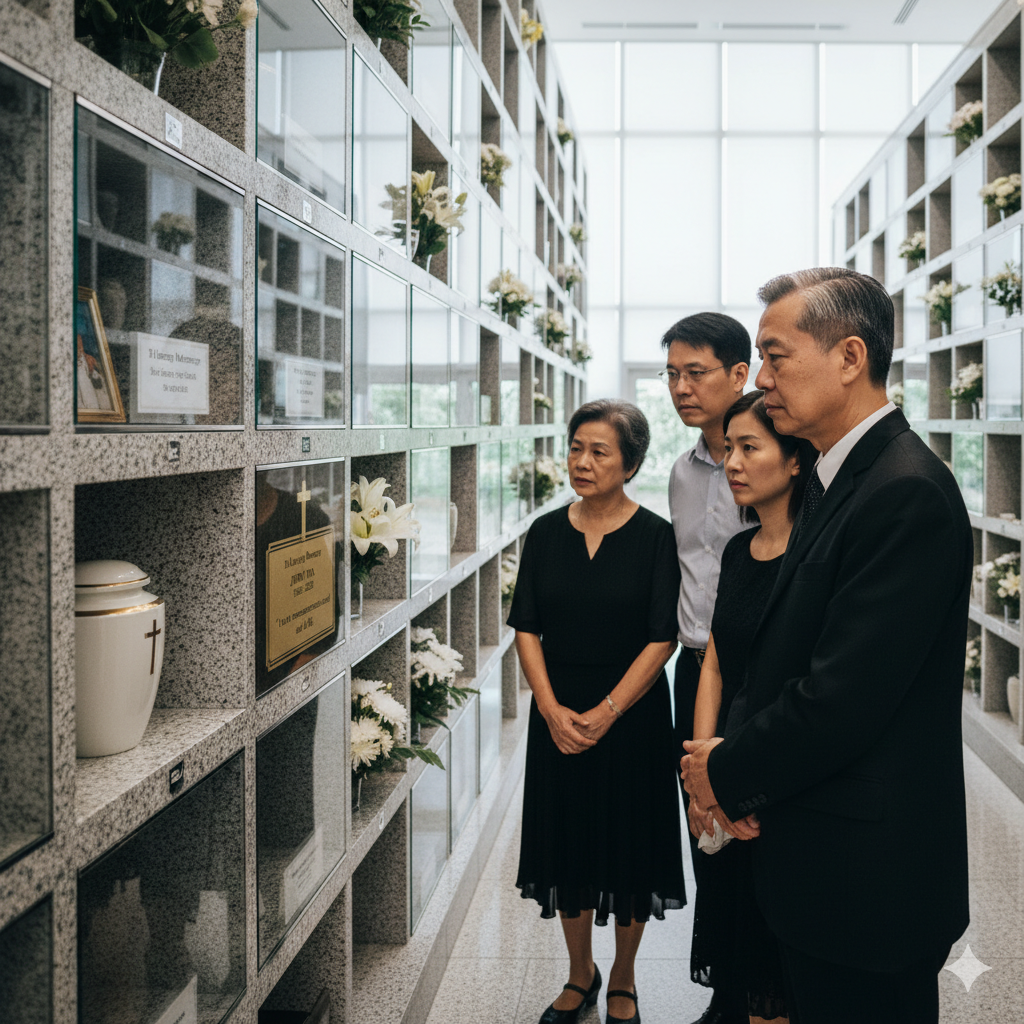
A columbarium niche is a dedicated space, usually inside a dedicated memorial building or temple, where an urn is permanently or semi-permanently placed. Columbaria have become central to Singapore’s cremation culture.
Types of Columbarium in Singapore
- Government-run columbaria managed by NEA
- Religious columbaria attached to temples, churches, or community organisations
- Private columbaria operated by funeral service providers
Choosing the right niche matters. Factors include location, religious affiliation, lease terms, niche size, and accessibility for family visits. Get the full breakdown on how to choose a columbarium niche.
| Niche Type | Approx. Cost (SGD) | Lease Term | Best For |
| Government niche (NEA) | $400 – $2,500 | 20 years, renewable | Budget-conscious families |
| Religious temple niche | $1,000 – $5,000 | Varies by institution | Families with strong religious ties |
| Private columbarium niche | $2,000 – $15,000+ | Perpetual or fixed | Families wanting premium facilities |
| Family niche (multiple urns) | $5,000 – $20,000+ | Varies | Families planning ahead together |
How the Funeral Process Works for Cremation in Singapore
Understanding the full funeral process helps you plan clearly and avoid surprises.
The funeral process in Singapore for a cremation typically follows this structure:
| Phase | Duration | Key Activities |
| Body collection and preparation | Within hours of death | Transport, embalming or preservation, dressing |
| Wake period | 1 to 3 days | Family and community prayers, viewing, rites |
| Funeral service | 2 to 4 hours | Religious or secular ceremony |
| Cremation | Same day as service | Transfer to crematorium, final rites, cremation |
| Ash collection | 1 to 2 days after cremation | Urn preparation, handover to family |
| Final placement | Within days or weeks | Columbarium, sea burial, or home placement |
For guidance on arranging the entire process, read how to arrange a funeral in Singapore. If you are dealing with an immediate loss, what to do when someone passes away in Singapore provides a clear step-by-step action list.
Funeral Packages for Cremation in Singapore
When you choose cremation, the funeral package you select determines everything from the level of service to the type of urn, wake setup, and post-service support.
What a Standard Cremation Funeral Package Covers:
|
Review available funeral packages in Singapore to compare what is included at different price points. Nirvana Singapore also offers a best funeral services in Singapore overview if you want to evaluate providers before committing.
Why More Families Are Planning Ahead for Cremation
Pre-need planning — arranging your funeral before you die — is growing alongside the rise in cremation. The two trends are connected.
When families understand the land constraints, burial period rules, and exhumation process, they tend to plan ahead and choose cremation. They do not want to put their children through the experience of exhumation. They do not want to leave an expensive and emotionally complex situation behind.
What Advance Funeral Planning Gives You
- You choose cremation on your terms, not under time pressure
- You select the funeral provider that fits your values and budget
- You document your religious and personal preferences in writing
- You lock in arrangements before costs rise further
- You remove a major burden from your family at their most difficult moment
Read the full case for benefits of advance funeral planning to see how planning ahead changes the experience for your family.
What Happens If You Still Choose Burial?
Burial remains legal and available in Singapore. If your religion requires it or personal preference points that way, it is still an option. But you should go in with clear expectations.
| What You Need to Know | Detail |
| Burial plot availability | Limited. New plots at Choa Chu Kang Cemetery only, subject to allocation |
| Burial period | 15 years. Plot is not yours permanently |
| After 15 years | Exhumation required. Remains are typically cremated at that point |
| Long-term cost | Higher than cremation when you include maintenance and future exhumation |
| Religious requirements | Muslim families must choose burial; all others have a choice |
| NEA permits | Required for burial and later for exhumation |
If burial is the right choice for your family, read the new burial policy in Singapore and the complete guide to religious customs and funeral rites in Singapore to plan correctly.
External Research and Global Context on Cremation Trends
Singapore is not alone in its shift toward cremation. The trend is visible across many urbanised countries with land constraints.
The National Funeral Directors Association (NFDA) cremation and burial report shows cremation rates in the United States surpassing 60% in recent years, with projections reaching 80% by 2040. The drivers — cost, simplicity, lack of land — mirror what Singapore is experiencing.
A 2023 study by the Cremation Society of Great Britain found cremation rates in the UK reaching 79%, with similar patterns in Japan, where cremation is near universal at over 99%.
The World Bank urban population data shows that as cities grow denser and land becomes scarce, cremation consistently becomes the dominant choice. Singapore’s trajectory follows this global pattern with its own specific policy and cultural context added.
Questions to Ask Before You Decide
Whether you are planning for yourself or helping a family member, these questions cut through the complexity.
|
Summary: Why Cremation Is Increasing in Singapore
| Driver | Impact on Cremation Rate |
| Land scarcity | Burial plots are limited and non-permanent |
| Burial period policy | 15-year limit makes burial a temporary solution |
| Exhumation burden | Future exhumation is expensive and emotionally demanding |
| Lower cost | Cremation is significantly cheaper over the long term |
| Religious acceptance | Most faiths in Singapore now accept cremation |
| Urbanisation | Dense living makes land-free options more practical |
| Pre-need planning growth | More families choosing cremation when planning ahead |
| Generational shift | Younger Singaporeans view burial as impractical |
The rise in cremation in Singapore is not a passing shift. It reflects permanent structural realities. Land will not grow. Government policy will not reverse. Costs will not drop. If you want to make a clear decision for yourself or your family, understanding these drivers gives you the foundation to do that.
Start by reviewing your options through best funeral services in Singapore, comparing funeral packages in Singapore, and reading about benefits of advance funeral planning.