The Hungry Ghost month, the seventh lunar month, runs from 13 August to 10 September in 2026, and Zhong Yuan Jie falls on 27 August. Two questions come up more than any others in that window: what you are allowed to bring in, and what you are supposed to do with it afterwards.
A columbarium is the building where urns of ashes are kept, each one in a small compartment called a niche. The rules below are the ones the National Environment Agency publishes for the government columbaria at Choa Chu Kang, Mandai and Yishun. Private facilities set their own house rules on top, so ask yours if anything here does not match what you see on site.
Check the opening hours before you plan the day
All three government columbaria open from 8.00am to 5.30pm daily. That is the figure to plan around this month.
The long hours earlier in the year were a separate arrangement: for Qing Ming in 2026, all three sites opened 24 hours a day from 21 March to 19 April. No equivalent extension has been published for the seventh lunar month, so an evening visit after work is not safe to assume. Private columbaria set their own hours, which often differ from the government ones.
One thing has changed at Choa Chu Kang this year. The back driveway is closed from May to October 2026 for repair works, so you cannot drive in or park in the lots there. The front carparks stay open and signage on site points to the burning pit. Allow extra time, and more walking than usual if an older relative is coming. For that site, the Choa Chu Kang site are set out separately.
Decide what goes inside the hall and what stays outside
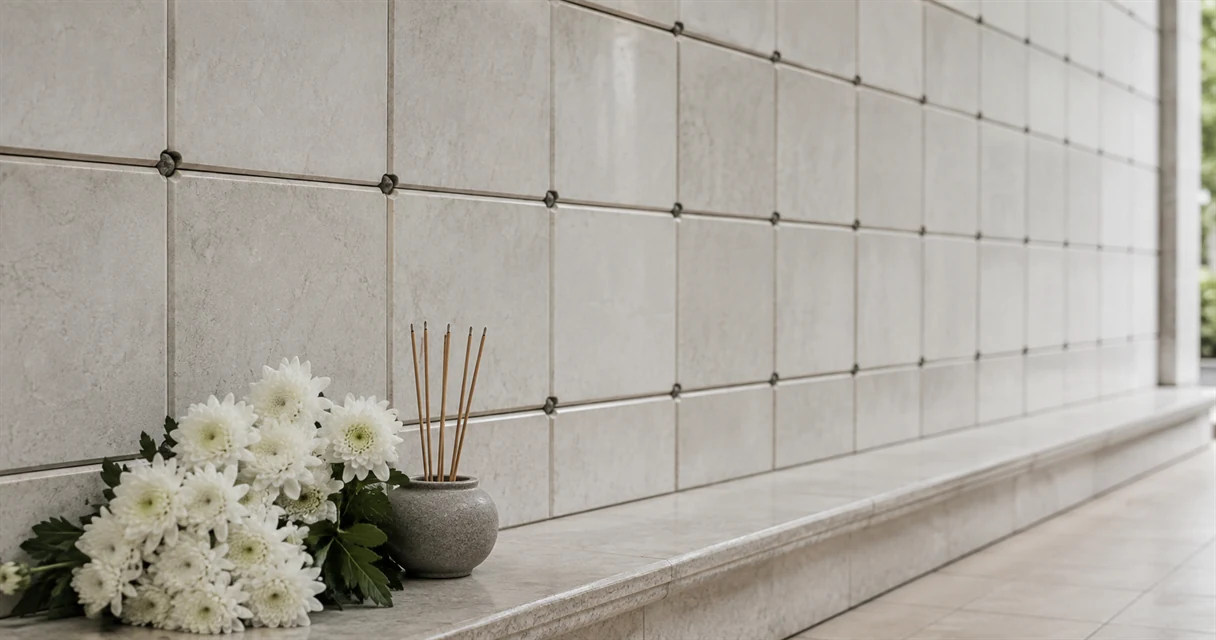
Flowers and incense are the usual items families bring to a niche. Food and other perishable items are not allowed inside niche rooms.
The reason is practical rather than religious. Food left in an enclosed hall attracts ants, rodents and birds, and staff have to clear it. If your family’s practice includes a food offering, lay it out at the designated area outside rather than at the niche, and plan to pack it up again.
What families typically carry in:
- Fresh flowers, usually white or yellow chrysanthemums
- Incense sticks for the niche itself
- Joss paper and paper offerings, for the burners rather than the hall
- Fruit and other food, which stays at the designated area outside
- A bag to take everything home in
Burn joss paper only in the burners provided
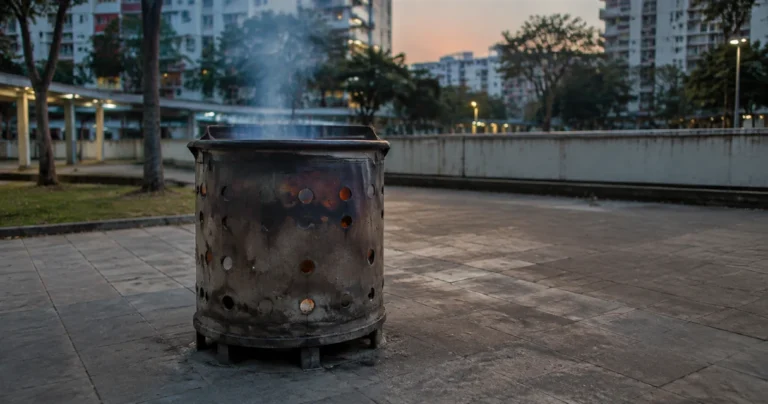
Every government columbarium has metal receptacles or concrete burners set aside for this. Joss paper, joss sticks, candles and large paper offerings belong in those, not at the niche and not anywhere else in the complex.
Burn in small handfuls rather than emptying a whole bundle at once. A packed burner smoulders instead of burning through, which is what produces the heavy smoke and the flakes of ash that drift over everyone in the queue behind you. Close the lid when you are done.
Large paper items are worth thinking about before you buy them. They are the offerings most likely to run into the burning restrictions, and a modest bundle burned properly causes nobody any trouble.
Take the food offerings home with you
Once the prayers are finished, clear everything you brought. Fruit, buns, drinks, candles and holders all go back into the bag they arrived in.
Offerings left behind may be cleared by staff, and leaving them can be treated as littering. The composition fine for a first littering offence is $300, and a first conviction in court carries a fine of up to $2,000. Worth knowing if anyone in the family believes the food is supposed to stay.
Burning at your own block follows different rules
Plenty of families burn offerings at home rather than at the columbarium, and this is where most complaints and fines actually arise.
Use the metal burners the town council places around the estate. The national advice, issued through the Municipal Services Office and echoed by the Civil Defence Force, is to burn inside those containers rather than on the ground, on grass, along walkways and driveways, or near parked vehicles. Many town councils also prohibit burning in corridors and at lift landings. Burn a small quantity at a time and make sure the embers are out before you leave.
| At a government columbarium | At your own block | |
|---|---|---|
| Joss paper | Only in the burners at the designated area | Only in the town council burner |
| Food offerings | Not inside niche rooms, taken home after | Cleared away once prayers are done |
| Joss sticks and candles | At the designated area, not at the niche | Inside the container, embers out before leaving |
| Timing | Within opening hours, 8.00am to 5.30pm | No fixed hours, but keep smoke away from homes |
Pick a quieter slot if the date allows
The weekend closest to Zhong Yuan Jie is the busiest stretch of the month, and the first and fifteenth days draw crowds too. If your family is flexible, a weekday morning is calmer, parking is easier, and older relatives are not queueing in the heat. Nothing in the customary practice requires the exact day.
If you are keeping up rites for a parent or grandparent, the meaning of the 100th day prayer explains how the fixed dates fit together. Where the concern is what you must avoid doing rather than what to bring, the prohibitions that carry real penalties covers that side.
If you cannot get there this year
Some families are overseas, some have no one well enough to travel, and some have no niche to visit yet because a death is recent. None of that is a failure. Where a family has ancestral tablets at a temple or hall, the tablet is where the rites are performed. Where the ashes are not yet placed, the seventh month has no bearing on timing, and choosing a niche is a decision families take at their own pace.
For this month, the practical version is short.
- Go inside opening hours, 8.00am to 5.30pm
- Bring flowers and incense to the niche
- Burn paper only in the burners at the designated area
- Lay food out outside the niche rooms, then take it home
- Go on a weekday if the family can manage it
Frequently Asked Questions
Are opening hours extended during the Hungry Ghost month?
No extension has been published for this period. Extended hours are published for Qing Ming, and in 2026 the three government columbaria opened 24 hours daily from 21 March to 19 April. Plan around normal hours of 8.00am to 5.30pm, or check the facility’s notice before travelling.
Can I burn joss paper at the columbarium?
Yes, but only in the metal receptacles or concrete burners at the designated burning areas. Nothing may be burned elsewhere in the complex. Burn a few pieces at a time so the paper burns through properly.
Can I leave food offerings at the niche?
No. Food and other perishable items are not allowed inside niche rooms, and anything left unattended may be cleared away. Lay food out at the designated area if your family’s practice calls for it, then take it home once the prayers are done.
Is parking affected at Choa Chu Kang this year?
Yes. The back driveway is closed from May to October 2026 for repair works, so vehicles cannot enter or park in the lots there. The front carparks remain open, and signage on site directs visitors to the burning pit.
Where can I burn joss paper at my HDB block?
Use the burners the town council provides in the common areas, rather than the ground, grass, walkways, driveways or anywhere near parked vehicles. Many town councils also prohibit burning in corridors and at lift landings, so check your own estate’s notices.
Opening hours, columbarium rules, the Choa Chu Kang driveway closure and littering penalties above are as published by the National Environment Agency. Guidance on burning in housing estates comes from the Municipal Services Office and the Civil Defence Force, and town councils add their own rules.