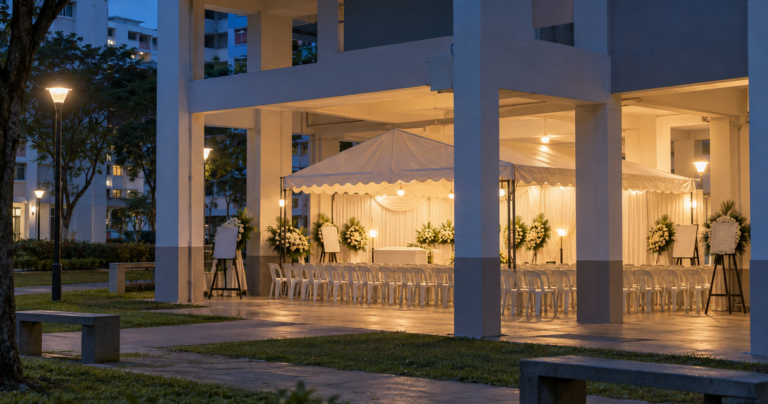
Someone has died, the wake is tonight, and the question that stops people at the lift lobby is not how to behave. It is how much.
There is no authority to look this up with. No government agency sets an amount, no temple publishes a rate, and asking the family is the one thing nobody wants to do. What exists instead is a convention, published fairly consistently by Singapore funeral providers and bereavement guides, and it is narrower than most people expect.
The amounts people actually give
Pek kim (白金), bai jin in Mandarin, means something close to “white gold”. It is money given to the bereaved family at a wake, and its original purpose was plain and practical: funerals cost money, and the people who came helped carry it.
The published bands cluster around relationship, not income:
| Your relationship to the family | Commonly given |
|---|---|
| Distant colleague, neighbour, acquaintance | $30 to $50 |
| Friend, or a colleague you know well | $50 to $100 |
| Close friend | $100 to $200 |
| Relative | $200 and above, more for immediate family |
| Student, or genuinely stretched | $20 to $30, and always acceptable |
That last row matters more than the others. The custom has never been a means test. A small amount given by someone who came is worth more to a grieving family than a large one from someone who did not, and nobody at the reception table is comparing.
If you want a single number and no deliberation: $50 covers most situations for most people.
The odd-number rule, and why nearly everyone breaks it
Published advice and actual practice pull apart on this one, and it causes more anxiety than it deserves.
At Chinese weddings, even numbers are auspicious, so $88 or $168 is the norm. At funerals the convention reverses. Odd amounts are traditional, which is why the guides recommend $30, $50, $70 or $90 rather than $80.
Then look at what people give. $50 is odd in its leading digit and universally accepted. $100 is even, and equally universal. Strict observers in some older Hokkien households resolve this by giving $51 or $101 precisely, to avoid a round even hundred. Most people give $50 or $100 without a second thought and no offence is taken.
So treat the odd-number rule as a tiebreaker, not a law. Where it does still hold firmly is the number four. Avoid any amount built around it, so not $40 and not $44, because 四 sounds like the word for death. That one is worth remembering.
- Safe and unremarkable: $50, or $100
- Strictly correct if someone in the family cares: $51, or $101
- Traditionally preferred: an odd leading digit, so $30, $70 or $90
- Avoid entirely: anything containing four, such as $40 or $44
The envelope, and the part people forget
Plain white. Never red. Red packets belong to celebrations and handing one over at a wake reads as a genuine mistake rather than a small one.
Write your full name on the envelope. This is the step that gets skipped, and it is the functional one. Families keep a record of who came and what was given, both to know who to thank and, in many households, to reciprocate when a death happens in that person’s family years later. An unnamed envelope cannot be entered in that record.
If you arrive without an envelope, ask at the reception table. Wakes at funeral parlours and HDB void decks keep plain white envelopes and a pen there precisely because guests turn up empty-handed.
The whole sequence at the reception table, in order.
- Take an envelope and pen if you did not bring one
- Put the notes in, and write your full name on the front
- Hand it to the family member at the counter, or place it in the condolence box
- Sign the condolence book
- Go through to pay your respects
The usual shape of a Singapore funeral explains where that table normally sits and what else happens around it.
Sending pek kim by PayNow
This is the newest wrinkle and the one with a trap in it.
Many families now display a printed PayNow QR code at the reception desk, or on the digital obituary screen at the parlour. It is socially accepted, and it is the normal solution when you genuinely cannot attend.
But a bank transfer arrives with a phone number, not a person. The reference field is what turns it back into pek kim, so put your full name in it. Some families run their record straight off the bank statement, and an unlabelled transfer is effectively anonymous. The giver gets no acknowledgement and the family is left guessing. If you are transferring while away, send a short private message to a family member as well, so the money is not the only thing that arrives.
When the family has asked for none
Obituaries sometimes state that no condolence money or wreaths are wanted, and occasionally that donations should go to a named charity instead.
Take that literally. Pressing an envelope on the family after they have said this puts them in the position of refusing you at a wake. If a charity is named, giving there and mentioning it quietly is the whole of the etiquette.
Other faiths and other wakes
Condolence money is not only a Chinese practice in Singapore, but it changes shape.
At Christian and Catholic wakes, including those of Chinese-Christian families, money is commonly given and accepted, though there is no religious rule behind it. Round figures such as $50 or $100 are ordinary, and the odd-number convention largely falls away. Where the two traditions meet, the differences are wider than the money, and what separates a Buddhist from a Christian funeral covers the rest.
At Malay-Muslim funerals the equivalent is duit takziah, given voluntarily. There is no odd or even convention and no expected range, and it is often given quietly rather than at a reception table.
The rites themselves differ enough that arriving informed helps. If the wake is Buddhist, Singapore Buddhist funeral customs sets out when to bow and when to stand back; if it is a Taoist wake, the sequence over several evenings is different again.
None of this is graded. Fill in your name, keep the envelope white, skip the fours, and go. The family will remember that you were there long after they have forgotten the number.
Frequently Asked Questions
How much pek kim should I give in Singapore?
Commonly $30 to $50 for an acquaintance or distant colleague, $50 to $100 for a friend or close colleague, $100 to $200 for a close friend, and $200 or more for a relative. If you want one figure that suits most situations, $50 is standard. No government or religious authority sets these amounts; they are conventions published by funeral providers and bereavement guides.
Should the amount be an odd number?
Traditionally yes, which reverses the wedding convention where even numbers are auspicious. In practice both $50 and $100 are given universally without issue. Strict observers give $51 or $101 to avoid an even hundred. The rule that still holds firmly is avoiding any amount containing four, such as $40, because 四 sounds like the word for death.
What colour envelope is used for condolence money?
Plain white, never red. Red packets are for celebrations. Write your full name on the envelope so the family can record who gave it. White envelopes and a pen are normally available at the reception table if you arrive without one.
Can I give condolence money through PayNow?
Yes. Many families display a PayNow QR code at the reception desk or on the digital obituary screen. Put your full name in the transfer reference field, because some families keep their record directly from the bank statement and an unlabelled transfer cannot be attributed.
What if the obituary says no condolence money?
Respect it exactly as written. If the family has named a charity instead, donate there and mention it briefly. Insisting on giving an envelope after the family has declined puts them in an awkward position at their own wake.
Is condolence money expected at a non-Chinese funeral?
It is commonly given at Christian and Catholic wakes in Singapore, usually in round amounts, with no religious rule behind it. At Malay-Muslim funerals the equivalent is duit takziah, given voluntarily, with no odd or even convention and no expected range.
The amounts, the odd-number convention and the envelope practice described here are conventions published consistently across multiple Singapore funeral providers and bereavement guides. No government agency or religious body sets or publishes a figure, and this article does not present one as official.