The seventh lunar month runs from 13 August to 10 September in 2026. Most of the advice circulating about it mixes two very different things together, and the difference matters.
Some of it is enforceable. Burn in the wrong place or leave offerings behind and there is a fine attached, issued by an agency, with an amount. The rest is custom. Nobody enforces it, families disagree about it, and observing it or not is a private matter.
This separates the two, because being told off by an elderly relative and being fined by an officer are not the same problem.
The rules that carry a penalty
Three things in this month can actually cost you money.
Leaving offerings behind is the common one. Food, fruit and paper left at a columbarium, a void deck or a roadside may be cleared by staff, and doing it can be treated as littering. The composition fine for a first littering offence is $300, and a first conviction in court carries a fine of up to $2,000.
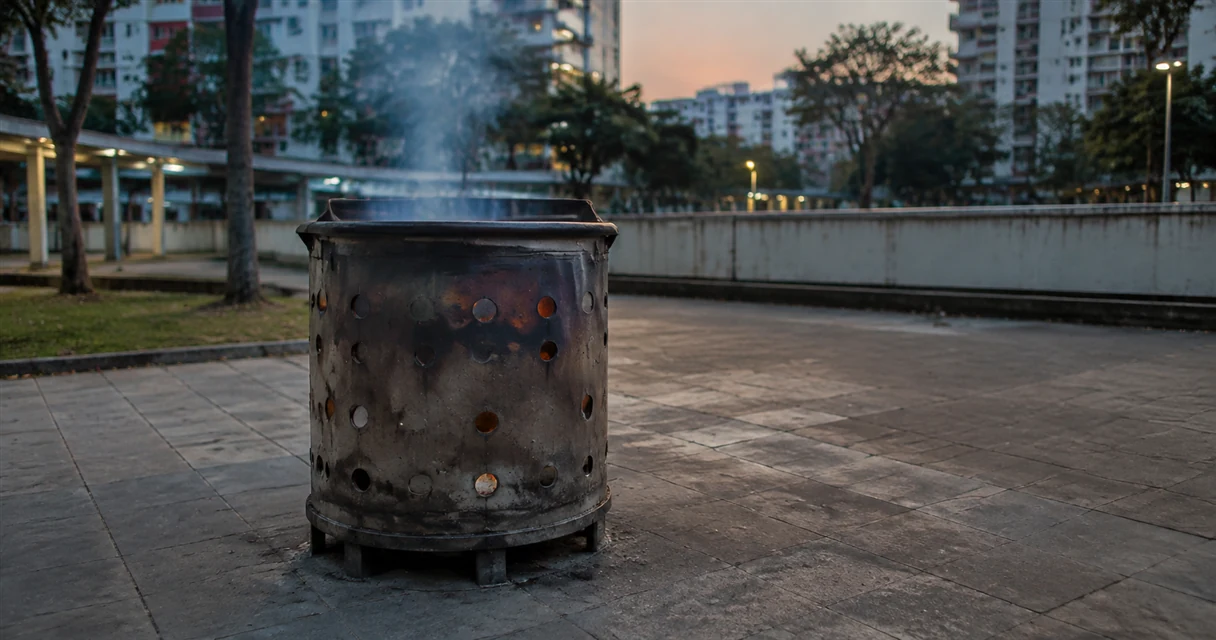
Burning outside a proper receptacle is the second. National guidance issued through the Municipal Services Office, echoed by the Civil Defence Force, is to burn inside the metal containers the town council provides rather than on the ground, on grass, along walkways and driveways, or anywhere near parked vehicles. Many town councils go further and prohibit burning in corridors and at lift landings entirely.
Obstruction is the third and the least expected. Offerings, burners and paper effigies placed where they block a walkway, a fire access route or a driveway are a matter for the town council, and they can be removed.
| Custom, not enforced | Carries a real penalty | |
|---|---|---|
| Offerings on the ground | Stepping around them | Leaving them behind to be cleared |
| Burning | Which paper you buy, and how much | Burning outside a proper receptacle |
| Placement | Facing a particular direction | Blocking a walkway or fire access |
| Timing | Avoiding the first and fifteenth days | Burning at a columbarium after closing |
| Clearing up | Bowing before you leave | Embers left alight when you walk away |
Do not burn like this, whatever the hurry
The practical failures repeat every year, and they are avoidable.
Do not tip a whole bundle into a burner at once. A packed burner smoulders instead of burning through, which is what sends thick smoke and burning flakes over everyone standing behind you. Feed it a handful at a time.
Do not leave before the embers are out. A container that looks finished can reignite in a breeze, and this is the single most common cause of a complaint escalating into a fire service call.
Do not burn oversized paper effigies at a site that cannot take them. Large items are the ones most likely to exceed what a burner can handle, and a columbarium burning pit is sized for ordinary bundles.
Four habits that prevent almost every complaint:
- Feed the burner in small handfuls and wait between them
- Keep burning at least a few metres clear of parked cars and dry grass
- Close the lid or let the container burn down before leaving
- Take everything you carried in back out with you
What not to do at a columbarium specifically
The government columbaria at Choa Chu Kang, Mandai and Yishun open 8.00am to 5.30pm daily, and there is no evening extension for the seventh month. Turning up after work expecting a late closing does not work. Extended hours are published for Qing Ming, not for this month.
Do not carry food into a niche room. Food and other perishable items are not allowed inside, for a practical reason rather than a spiritual one: it draws ants, rodents and birds into an enclosed hall. The designated area outside is where a food offering belongs.
Do not burn anything at the niche itself. Burning happens only in the metal receptacles or concrete burners at the designated area, never in the halls or on the grounds.
At Choa Chu Kang there is one more this year. Do not plan on the back driveway, which is closed from May to October 2026 for repair works. The front carparks stay open and signage points to the burning pit. The full list of what you can and cannot bring covers the items side in detail.
The customs, which are not rules
These are the ones people mean by taboos. None is enforced by anyone, and families vary widely in how seriously they take them.
Do not step on or over roadside offerings. This is the one nearly everyone observes regardless of belief. Kicking over a burner or scattering someone’s offerings is the version that genuinely offends.
Do not take food from a roadside offering. Some families leave fruit and snacks out deliberately, and the convention is that it is not yours.
Beyond those two, the list runs long and gets less consistent. The ones raised most often:
- Avoid swimming at night, and open water after dark generally
- Do not hang laundry outdoors overnight
- Do not whistle at night, or call someone by name in the dark
- Avoid moving house, or holding a wedding, during the month
- Leave the front row empty at a getai performance, since those seats are not for the living
Older relatives may hold to all of these. Others keep none of them. Neither position is incorrect, and no facility or authority takes a view.
One belief is worth naming because it causes real distress. Visiting a niche during the seventh month is sometimes said to be unlucky or unwelcome. No published guidance discourages it, the columbaria keep normal hours throughout, and visitor numbers are at their highest in exactly this period. If someone in the family is anxious about going, that is the fact to give them.
What not to assume about your own family
The hardest part of this month is rarely the rules. It is that two branches of a family often observe different things, and each assumes the other is doing it wrong.
Do not assume the practice you grew up with is the standard one. Chinese Singaporean customs vary by dialect group, by whether the family is Buddhist, Taoist or neither, and by how much was carried over from a village practice two generations back. Taoist funeral practices and Buddhist funeral customs diverge in ways that surface in this month too.
Do not assume a bigger offering counts for more. It does not, and it is the fastest route to the burning restrictions above.
And do not assume anyone is keeping score. Why the rites persist at all has more to do with remembering than with correctness. The hundredth day observance sets out the fixed dates that sit around this month.
The month asks very little of anyone. Burn in the container, take your things home, walk around what is on the pavement. Everything past that is between a family and its own memory.
Frequently Asked Questions
What is actually illegal during the Hungry Ghost month?
Nothing about the observance itself. What carries a penalty is littering, which covers offerings left behind, and burning outside a proper receptacle. The composition fine for a first littering offence is $300, and a first conviction in court carries a fine of up to $2,000.
Where must I not burn joss paper?
Not on the ground, on grass, along walkways or driveways, or near parked vehicles. National guidance through the Municipal Services Office and the Civil Defence Force is to use the metal containers the town council provides. Many town councils also prohibit burning in corridors and at lift landings.
Is it bad luck to visit a columbarium during the seventh month?
No published rule or guidance discourages it. The government columbaria keep their normal 8.00am to 5.30pm hours throughout the month, and visitor numbers are at their highest during this period, particularly around Zhong Yuan Jie.
What happens if I step on a roadside offering?
Nothing official. It is a matter of courtesy rather than regulation, and walking around offerings is the convention almost everyone follows. Deliberately kicking over a burner or scattering an offering is what causes genuine offence.
Can I hold a wedding or move house during the Hungry Ghost month?
There is no rule against it. Avoiding both is a widely held custom rather than a requirement, and families differ on whether they observe it. Venues and movers operate normally throughout the month.
Must I take food offerings home from a columbarium?
Yes. Food and perishables are not allowed inside niche rooms, and anything left unattended may be cleared away and can be treated as littering. Lay food out at the designated area outside, then pack it up once the prayers are done.
Littering penalties, columbarium opening hours and burning rules above are as published by the National Environment Agency. Guidance on burning within housing estates comes from the Municipal Services Office and the Civil Defence Force, with individual town councils setting additional rules. The customary practices described are widely observed conventions and are not set by any authority.